IP Court ruling of 27.04.2016 (MAXIMUS)
| Case | MAXIMUS trademark dispute — Арбитраж · 2015–2016 |
|---|---|
| Date | |
| Document type | Court decision |
| Instance | Cassation |
| Court | Суд по интеллектуальным правам |
| Pages | 10 |
| Source | Материалы дела |
| Added | 08.10.2026 |
This material has been redacted to protect personal data: names of all persons (except the surname Artsinovich), case and act numbers, signatures, seals and identifiers are hidden and cannot be recovered from the image or text.
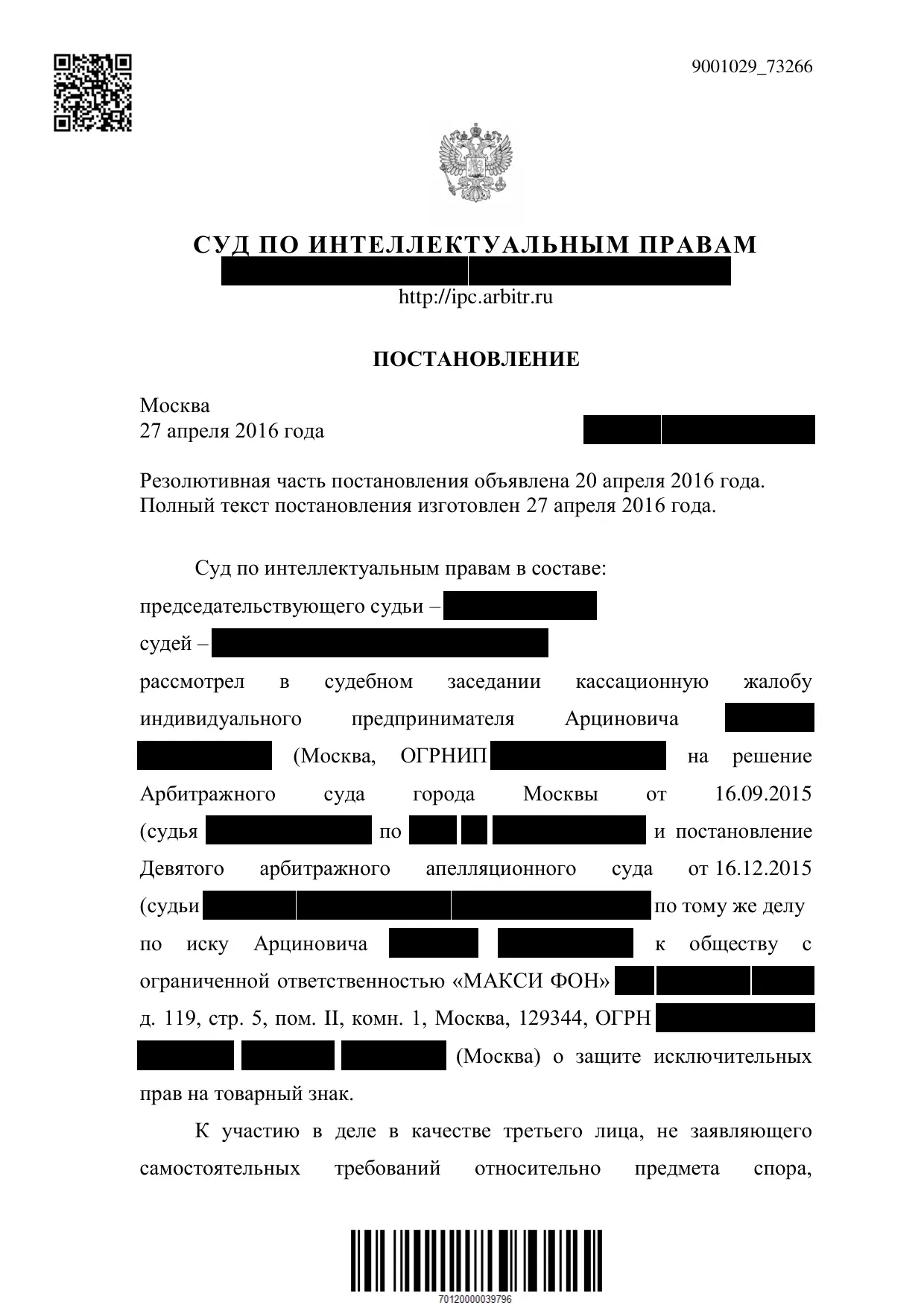
Text version
1
9001029_73266
СУД ПО ИНТЕЛЛЕКТУАЛЬНЫМ ПРАВАМ
[скрыто][скрыто]
ПОСТАНОВЛЕНИЕ Москва 27 апреля 2016 года [скрыто] Резолютивная часть постановления объявлена 20 апреля 2016 года. Полный текст постановления изготовлен 27 апреля 2016 года.
Суд по интеллектуальным правам в составе:
председательствующего судьи – [скрыто] [скрыто],
судей – [скрыто] [скрыто], [скрыто] [скрыто],
рассмотрел в судебном заседании кассационную жалобу
индивидуального предпринимателя Арциновича [скрыто]
[скрыто] (Москва, ОГРНИП [скрыто]) на решение
Арбитражного суда города Москвы от 16.09.2015
(судья [скрыто] [скрыто]) по [скрыто] и постановление
Девятого арбитражного апелляционного суда от 16.12.2015
(судьи [скрыто] [скрыто], [скрыто] [скрыто], [скрыто] [скрыто]) по тому же делу
по иску Арциновича [скрыто] [скрыто] к обществу с
ограниченной ответственностью «МАКСИ ФОН» ([скрыто][скрыто]
д. 119, стр. 5, пом. II, комн. 1, Москва, 129344, ОГРН [скрыто]),
[скрыто] [скрыто] [скрыто] (Москва) о защите исключительных
прав на товарный знак.
К участию в деле в качестве третьего лица, не заявляющего
самостоятельных требований относительно предмета спора,
2
2
привлечено акционерное общество «РЕГИОНАЛЬНЫЙ СЕТЕВОЙ
ИНФОРМАЦИОННЫЙ ЦЕНТР» (ул. [скрыто]
Москва, 123308, ОГРН [скрыто]).
В судебном заседании приняли участие представители:
[скрыто]
(по доверенности от 13.02.2015);
от общества с ограниченной ответственностью «МАКСИ ФОН»:
[скрыто] [скрыто] (по доверенности от 01.06.2015).
Суд по интеллектуальным правам
УСТАНОВИЛ:
индивидуальный предприниматель Арцинович [скрыто] [скрыто]
(далее – предприниматель) обратился в Арбитражный суд города
Москвы с исковым заявлением к обществу с ограниченной
ответственностью «МАКСИ ФОН» (далее – общество «МАКСИ ФОН»)
и [скрыто] [скрыто] [скрыто] о защите исключительных прав на
товарный знак (с учетом принятых судом уточнений исковых
требований в порядке статьи 49 Арбитражного процессуального
кодекса Российской Федерации).
В порядке статьи 51 Арбитражного процессуального кодекса
Российской Федерации к участию в деле в качестве третьего лица, не
заявляющего самостоятельных требований относительно предмета
спора, привлечено акционерное общество «РЕГИОНАЛЬНЫЙ
СЕТЕВОЙ ИНФОРМАЦИОННЫЙ ЦЕНТР».
В связи с принятием судом первой инстанции отказа
предпринимателя от заявленных к [скрыто] [скрыто] требований в порядке
статьи 49 Арбитражного процессуального кодекса Российской
Федерации, производство по делу в указанной части прекращено.
Решением Арбитражного суда города Москвы от 16.09.2015 в
удовлетворении иска отказано.
3
3
Постановлением Девятого арбитражного апелляционного суда
от 16.12.2015 решение суда первой инстанции оставлено без
изменений.
В кассационной жалобе, поданной в Суд по интеллектуальным
правам, предприниматель, ссылаясь на несоответствие выводов судов
фактическим обстоятельствам дела и имеющимся в деле
доказательствам, неправильное применение норм материального права,
просит решение суда первой инстанции и постановление суда
апелляционной инстанции отменить, дело направить на новое
рассмотрение в суд первой инстанции. Так, заявитель жалобы
указывает на неустановление судами таких, по его мнению,
существенных обстоятельств, имеющих значение для правильного
рассмотрения дела, как использование обществом «МАКСИ ФОН»
товарного знака по свидетельству Российской Федерации [скрыто],
факта нарушения обществом «МАКСИ ФОН» его прав в связи с
использованием товарного знака по свидетельству Российской
Федерации [скрыто] в составе доменного имени maximus.ru.
В судебном заседании представитель предпринимателя выступил
по доводам кассационной жалобы, просил ее удовлетворить,
обжалуемые решение суда первой инстанции и постановление суда
апелляционной инстанции отменить.
Представитель общества «МАКСИ ФОН» в отзыве и в судебном
заседании против удовлетворения кассационной жалобы возражал,
считая ее доводы необоснованными и не подлежащими
удовлетворению. Обжалуемые судебные акты просил оставить без
изменения.
Третье лицо, надлежащим образом извещенное о времени и месте
судебного заседания, в том числе путем публичного уведомления на
официальном сайте Суда по интеллектуальным правам
4
4
http://ipc.arbitr.ru, своих представителей в судебное заседание не
направило, что в соответствии с частью 3 статьи 284 Арбитражного
процессуального кодекса Российской Федерации не является
препятствием для рассмотрения дела в его отсутствие. Отзыв третье
лицо также не представило.
В силу части 1 статьи 286 Арбитражного процессуального
кодекса Российской Федерации суд кассационной инстанции проверяет
законность решений, постановлений, принятых арбитражным судом
первой и апелляционной инстанций, устанавливая правильность
применения норм материального права и норм процессуального права
при рассмотрении дела и принятии обжалуемого судебного акта и
исходя из доводов, содержащихся в кассационной жалобе и
возражениях относительно жалобы, если иное не предусмотрено
названным Кодексом.
Рассмотрев кассационную жалобу, проверив в порядке статей 286
и 287 Арбитражного процессуального кодекса Российской Федерации
правильность применения судом первой инстанции и судом
апелляционной инстанции норм материального права и соблюдения
норм процессуального права при принятии обжалуемых судебных
актов, а также соответствие выводов судов установленным
фактическим обстоятельствам дела и имеющимся в деле
доказательствам, Суд по интеллектуальным правам приходит к выводу
об отсутствии правовых оснований для удовлетворения кассационной
жалобы в связи со следующим.
Как следует из материалов дела и установлено судами,
предприниматель является правообладателем словесного товарного
знака «MAXIMUS» по свидетельству Российской Федерации [скрыто],
зарегистрированного в отношении услуг 35-го класса Международной
классификации товаров и услуг для регистрации знаков
5
5
(далее – МКТУ) («продвижение товаров (для третьих лиц);
снабженческие услуги для третьих лиц (закупка товаров и услуги
предприятиям)») и 42-го класса МКТУ («дизайн художественный;
услуги дизайнеров в области упаковки») (дата подачи заявки
от 30.12.2002, дата регистрации от 20.04.2004).
На основании договора отчуждения исключительных прав,
зарегистрированным 19.11.2014 за номером [скрыто], общество
«МАКСИ ФОН» является правообладателем комбинированного
товарного знака со словесным обозначением «МАКСИМУС» по
свидетельству Российской Федерации [скрыто], зарегистрированного
в том числе в отношении услуг 35-го класса МКТУ («реклама;
менеджмент в сфере бизнеса; административная деятельность в сфере
бизнеса; офисная служба») (дата подачи заявки от 11.09.2002, дата
регистрации от 05.06.2003).
Общество «МАКСИ ФОН» с 25.12.2013 является одной из
компаний, входящих в Группу компаний «Максимус». Основным
видом деятельности общества «МАКСИ ФОН», как и остальных
компаний из Группы компаний «Максимус», является оптовая торговля
электротоварами и бытовыми электроустановочными изделиями, а
также деятельность в области телефонной связи и документальной
электросвязи.
Администратором спорного доменного имени maximus.ru
является с 15.05.2015 общество «МАКСИ ФОН». На сайте с доменным
именем maximus.ru обществом «МАКСИ ФОН» размещается рекламная
информация и предложение к продаже товаров.
Исковые требования мотивированы тем, что, по мнению
предпринимателя, общество «МАКСИ ФОН» нарушило его
исключительные права путем использования без его согласия в
доменном имени maximus.ru обозначения, сходного до степени
6
6
смешения с товарным знаком предпринимателя по свидетельству
Российской Федерации [скрыто], зарегистрированного в отношении
однородных услуг, в связи с чем он обратился в Арбитражный суд
города Москвы с настоящим иском.
Отказывая в удовлетворении заявленных требований, суды
первой и апелляционной инстанций исходили из следующего.
В соответствии со статьей 1229 Гражданского кодекса
Российской Федерации (далее – ГК РФ) гражданин или юридическое
лицо, обладающие исключительным правом на результат
интеллектуальной деятельности или на средство индивидуализации
(правообладатель), вправе использовать такой результат или такое
средство по своему усмотрению любым не противоречащим закону
способом. Правообладатель может распоряжаться исключительным
правом на результат интеллектуальной деятельности, если названным
Кодексом не предусмотрено иное. Правообладатель может по своему
усмотрению разрешать или запрещать другим лицам использование
результата интеллектуальной деятельности или средства
индивидуализации. Отсутствие запрета не считается согласием
(разрешением). Другие лица не могут использовать соответствующие
результат интеллектуальной деятельности или средство
индивидуализации без согласия правообладателя, за исключением
случаев, предусмотренных этим Кодексом.
Использование результата интеллектуальной деятельности или
средства индивидуализации (в том числе их использование способами,
предусмотренными ГК РФ), если такое использование осуществляется
без согласия правообладателя, является незаконным и влечет
ответственность, установленную ГК РФ, другими законами, за
исключением случаев, когда использование результата
интеллектуальной деятельности или средства индивидуализации
7
7
лицами иными, чем правообладатель, без его согласия допускается
ГК РФ.
Согласно статье 1484 ГК РФ лицо, на имя которого
зарегистрирован товарный знак (правообладателю), принадлежит
исключительное право использования товарного знака в соответствии
со статьей 1229 ГК РФ любым не противоречащим закону способом
(исключительное право на товарный знак). Правообладатель может
распоряжаться исключительным правом на товарный знак.
Исключительное право на товарный знак может быть
осуществлено для индивидуализации товаров, работ или услуг, в
отношении которых товарный знак зарегистрирован, в частности путем
размещения товарного знака: на товарах, в том числе на этикетках,
упаковках товаров, которые производятся, предлагаются к продаже,
продаются, демонстрируются на выставках и ярмарках или иным
образом вводятся в гражданский оборот на территории Российской
Федерации, либо хранятся или перевозятся с этой целью, либо ввозятся
на территорию Российской Федерации; при выполнении работ,
оказании услуг; на документации, связанной с введением товаров в
гражданский оборот; в предложениях о продаже товаров, о выполнении
работ, об оказании услуг, а также в объявлениях, на вывесках и в
рекламе; в сети «Интернет», в том числе в доменном имени и при
других способах адресации.
В соответствии с пунктом 14.4.3 Правил составления, подачи и
рассмотрения заявки на регистрацию товарного знака и знака
обслуживания, утвержденных приказом Российского агентства по
патентам и товарным знакам от 05.03.2003 [скрыто], для установления
однородности товаров принимается во внимание род (вид) товаров, их
назначение, вид материала, из которого они изготовлены, условия
сбыта товаров, круг потребителей и другие признаки.
8
8
В соответствии с частью 1 статьи 65 Арбитражного
процессуального кодекса Российской Федерации каждое лицо,
участвующее в деле, должно доказать обстоятельства, на которые оно
ссылается как на основание своих требований и возражений.
Лица, участвующие в деле, несут риск наступления последствий
совершения или несовершения ими процессуальных действий (часть 2
статьи 9 Арбитражного процессуального кодекса Российской
Федерации).
Отказывая в удовлетворении исковых требований, суды первой и
апелляционной инстанций установили, что доменное имя maximus.ru
является воспроизведением буквами латинского алфавита обозначения
«Максимус» – словесного элемента комбинированного товарного знака
по свидетельству Российской Федерации [скрыто],
зарегистрированного на имя ответчика ранее даты регистрации
товарного знака истца по свидетельству Российской Федерации
[скрыто], в связи с чем ответчик использует свой товарный знак,
который имеет более раннюю дату приоритета, чем товарный знак
истца.
Также судами установлено, что доказательств использования
обществом «МАКСИ ФОН» товарного знака предпринимателя путем
размещения его в доменном имени maximus.ru для реализации услуг
35-го класса МКТУ («продвижение товаров (для третьих лиц);
снабженческие услуги для третьих лиц (закупка товаров и услуги
предприятиям)») в материалы дела не представлено.
Оценив представленные в материалы дела доказательства в их
совокупности и взаимной связи, суды первой и апелляционной
инстанций пришли к выводу об отсутствии в действиях общества
«МАКСИ ФОН» нарушения исключительных прав предпринимателя на
товарный знак по свидетельству Российской Федерации [скрыто]
9
9
Суд кассационной инстанции считает, что выводы судов первой и
апелляционной инстанций основаны на всестороннем, полном,
объективном и непосредственном исследовании имеющихся в деле
доказательств в соответствии с частью 1 статьи 71, частью 2 статьи 271
Арбитражного процессуального кодекса Российской Федерации.
Фактические обстоятельства, имеющие значение для дела,
установлены судами на основании полного и всестороннего
исследования имеющихся в деле доказательств, выводы судов о
применении норм права соответствуют установленным
обстоятельствам и имеющимся доказательствам.
В целом доводы заявителя кассационной жалобы сводятся к его
несогласию с осуществленной судами оценкой представленных в
материалы дела доказательств, и не свидетельствуют о неправильном
применении или толковании судом первой и апелляционной инстанций
норм материального и процессуального права.
В связи с тем, что пределы рассмотрения дела в суде
кассационной инстанции ограничены проверкой правильности
применения судами норм материального и процессуального права, а
также соответствия их выводов о применении норм права
установленным по делу обстоятельствам и имеющимся в деле
доказательствам (части 1 и 3 статьи 286 Арбитражного
процессуального кодекса Российской Федерации), оснований для
отмены или изменения принятых судебных актов не имеется.
Несогласие заявителя кассационной жалобы с соответствующими
выводами судов связано с неверным толкованием им норм
материального права, что не свидетельствует о судебной ошибке и не
может являться основанием для отмены обжалуемых судебных актов.
Нарушений норм материального и процессуального права,
являющихся в соответствии со статьей 288 Арбитражного
10
10
процессуального кодекса Российской Федерации основанием для
отмены судебных актов, судом кассационной инстанции не
установлено.
С учетом изложенного обжалуемые судебные акты подлежат
оставлению без изменения, кассационная жалоба – без удовлетворения.
Судебные расходы по оплате госпошлины за подачу
кассационной жалобы относятся на ее заявителя в соответствии со
статьей 110 Арбитражного процессуального кодекса Российской
Федерации.
Руководствуясь статьями 286, 287, 288, 289 Арбитражного
процессуального кодекса Российской Федерации, Суд по
интеллектуальным правам
ПОСТАНОВИЛ:
решение Арбитражного суда города Москвы от 16.09.2015 по [скрыто] и постановление Девятого арбитражного
апелляционного суда от 16.12.2015 по тому же делу оставить без
изменения, кассационную жалобу индивидуального предпринимателя
Арциновича [скрыто] [скрыто] – без удовлетворения.
Постановление вступает в законную силу со дня его принятия.
Председательствующий судья
[скрыто] [скрыто]
[скрыто] [скрыто] [скрыто]
[скрыто] [скрыто] [скрыто]
Unofficial translation.
Judgment of the Intellectual Property Court of 27 April 2016, case [скрыто] (MAXIMUS trademark, cassation)
[[PAGE 1]]
[Document [скрыто]]
[скрыто] [скрыто] [скрыто]
Ogorodny Proezd 5, building 2, Moscow, 127254 — http://ipc.arbitr.ru
JUDGMENT
Moscow — 27 April 2016 — Case [скрыто]
The operative part of the judgment was announced on 20 April 2016. The full text of the judgment was drawn up on 27 April 2016.
The Intellectual Property Court, composed of presiding judge [скрыто] [скрыто] [скрыто] and judges [скрыто] [скрыто] [скрыто] and [скрыто] [скрыто] [скрыто], examined at a hearing the cassation appeal of individual entrepreneur [скрыто] [скрыто] Artsinovich (Moscow, entrepreneur registration number [скрыто]) against the decision of the Arbitrazh Court of the City of Moscow of 16.09.2015 ([скрыто] [скрыто] [скрыто] [скрыто]) in case [скрыто] and the judgment of the Ninth Arbitrazh Court of Appeal of 16.12.2015 ([скрыто] [скрыто] [скрыто] [скрыто], [скрыто] [скрыто] [скрыто], [скрыто] [скрыто] [скрыто]) in the same case, on the claim of [скрыто] [скрыто] Artsinovich against the limited liability company "[скрыто] [скрыто]" (Prospekt Mira 119, building 5, premises II, room 1, Moscow, 129344, main state registration number [скрыто])
[[PAGE 2]]
and [скрыто] [скрыто] [скрыто] (Moscow) for the protection of exclusive rights to a trademark.
The joint-stock company "[скрыто] [скрыто] [скрыто] [скрыто]" (3rd [скрыто], building 1, Moscow, 123308, main state registration number [скрыто]) was joined to the case as a third party not making independent claims in respect of the subject matter of the dispute.
The following representatives took part in the hearing: for [скрыто] [скрыто] Artsinovich — [скрыто] [скрыто] [скрыто] (by power of attorney of 13.02.2015); for the limited liability company "[скрыто] [скрыто]" — [скрыто] [скрыто] [скрыто] (by power of attorney of 01.06.2015).
The Intellectual Property Court
[скрыто] [скрыто]:
Individual entrepreneur [скрыто] [скрыто] Artsinovich (hereinafter — the entrepreneur) applied to the Arbitrazh Court of the City of Moscow with a statement of claim against the limited liability company "[скрыто] [скрыто]" (hereinafter — the company "[скрыто] [скрыто]") and [скрыто] [скрыто] [скрыто] for the protection of exclusive rights to a trademark (taking account of the clarifications of the claims accepted by the court under Article 49 of the Arbitrazh Procedure Code of the Russian Federation).
Under Article 51 of the Arbitrazh Procedure Code of the Russian Federation, the joint-stock company "[скрыто] [скрыто] [скрыто] [скрыто]" was joined to the case as a third party not making independent claims in respect of the subject matter of the dispute.
In view of the acceptance by the court of first instance of the entrepreneur's withdrawal of the claims made against [скрыто] [скрыто] [скрыто] under Article 49 of the Arbitrazh Procedure Code of the Russian Federation, the proceedings in that part were terminated.
By decision of the Arbitrazh Court of the City of Moscow of 16.09.2015 the claim was dismissed.
[[PAGE 3]]
By judgment of the Ninth Arbitrazh Court of Appeal of 16.12.2015 the decision of the court of first instance was upheld.
In the cassation appeal lodged with the Intellectual Property Court, the entrepreneur, relying on the inconsistency between the courts' conclusions and the actual circumstances of the case and the evidence available in the case, and on the incorrect application of the rules of substantive law, seeks the setting aside of the decision of the court of first instance and of the judgment of the appellate court, and the referral of the case for fresh examination to the court of first instance. In particular, the appellant states that the courts failed to establish what he considers to be significant circumstances of importance for the correct examination of the case, namely the use by the company "[скрыто] [скрыто]" of the trademark under Russian Federation certificate [скрыто], and the fact of the infringement by the company "[скрыто] [скрыто]" of his rights through the use of the trademark under Russian Federation certificate [скрыто] as part of the domain name maximus.ru.
[Translator's note: the certificate number "267343" appears as such in the original; elsewhere in the case the claimant's trademark is certificate [скрыто]]
At the hearing the entrepreneur's representative made submissions on the arguments of the cassation appeal and sought its allowance and the setting aside of the decision of the court of first instance and of the judgment of the appellate court appealed against.
The representative of the company "[скрыто] [скрыто]", in its response and at the hearing, objected to the cassation appeal being allowed, considering its arguments to be unfounded and not liable to be allowed. It sought the upholding of the judicial acts appealed against.
The third party, duly notified of the time and place of the hearing, including by public notice on the official website of the Intellectual Property Court
[[PAGE 4]]
http://ipc.arbitr.ru, did not send its representatives to the hearing, which, under Article 284(3) of the Arbitrazh Procedure Code of the Russian Federation, does not preclude the examination of the case in its absence. The third party also failed to submit a response.
Under Article 286(1) of the Arbitrazh Procedure Code of the Russian Federation, the court of cassation verifies the lawfulness of the decisions and judgments adopted by the arbitrazh court of first instance and the appellate court, establishing the correctness of the application of the rules of substantive law and of the rules of procedural law in the examination of the case and in the adoption of the judicial act appealed against, and proceeding on the basis of the arguments contained in the cassation appeal and in the objections to the appeal, unless otherwise provided by that Code.
Having examined the cassation appeal, and having verified, under Articles 286 and 287 of the Arbitrazh Procedure Code of the Russian Federation, the correctness of the application by the court of first instance and the appellate court of the rules of substantive law and their compliance with the rules of procedural law in adopting the judicial acts appealed against, as well as the correspondence of the courts' conclusions to the actual circumstances of the case established and to the evidence available in the case, the Intellectual Property Court concludes that there are no legal grounds for allowing the cassation appeal, for the following reasons.
As is apparent from the case file and as established by the courts, the entrepreneur is the holder of the verbal trademark "MAXIMUS" under Russian Federation certificate [скрыто], registered in respect of services in class 35 of the International Classification of Goods and Services for the Purposes of the Registration of Marks
[[PAGE 5]]
(hereinafter — the Nice Classification) ("promotion of goods (for third parties); procurement services for third parties (purchase of goods and services for undertakings)") and in class 42 of the Nice Classification ("artistic design; designers' services in the field of packaging") (application filing date 30.12.2002, registration date 20.04.2004).
On the basis of an agreement on the alienation of exclusive rights, registered on 19.11.2014 under number [скрыто], the company "[скрыто] [скрыто]" is the holder of a combined trademark with the verbal designation "МАКСИМУС" under Russian Federation certificate [скрыто], registered inter alia in respect of services in class 35 of the Nice Classification ("advertising; business management; business administration; office functions") (application filing date 11.09.2002, registration date 05.06.2003).
Since 25.12.2013 the company "[скрыто] [скрыто]" has been one of the companies forming part of the "Maximus" group of companies. The main activity of the company "[скрыто] [скрыто]", like that of the other companies in the "Maximus" group, is the wholesale trade in electrical goods and household electrical installation products, as well as activities in the field of telephone communications and documentary telecommunications.
Since 15.05.2015 the administrator of the disputed domain name maximus.ru has been the company "[скрыто] [скрыто]". On the website with the domain name maximus.ru the company "[скрыто] [скрыто]" places advertising information and offers of goods for sale.
The claims are based on the entrepreneur's view that the company "[скрыто] [скрыто]" infringed his exclusive rights by using, without his consent, in the domain name maximus.ru a designation confusingly
[[PAGE 6]]
similar to the entrepreneur's trademark under Russian Federation certificate [скрыто], registered in respect of similar services, which is why he applied to the Arbitrazh Court of the City of Moscow with the present claim.
In dismissing the claims, the courts of first instance and of appeal proceeded as follows.
Under Article 1229 of the Civil Code of the Russian Federation (hereinafter — the CC RF), a citizen or legal person holding the exclusive right to a result of intellectual activity or to a means of individualisation (the right holder) is entitled to use such result or such means at its discretion by any means not contrary to law. The right holder may dispose of the exclusive right to a result of intellectual activity, unless otherwise provided by that Code. The right holder may at its discretion permit or prohibit the use by other persons of the result of intellectual activity or of the means of individualisation. The absence of a prohibition is not deemed to be consent (permission). Other persons may not use the relevant result of intellectual activity or means of individualisation without the right holder's consent, except in the cases provided for by that Code.
The use of a result of intellectual activity or of a means of individualisation (including their use by the methods provided for by the CC RF), where such use is carried out without the right holder's consent, is unlawful and entails the liability established by the CC RF and by other laws, except where the use of a result of intellectual activity or of a means of individualisation
[[PAGE 7]]
by persons other than the right holder, without its consent, is permitted by the CC RF.
Under Article 1484 of the CC RF, the person in whose name a trademark is registered (the right holder) holds the exclusive right to use the trademark in accordance with Article 1229 of the CC RF by any means not contrary to law (the exclusive right to a trademark). The right holder may dispose of the exclusive right to the trademark.
The exclusive right to a trademark may be exercised for the individualisation of goods, works or services in respect of which the trademark is registered, in particular by placing the trademark: on goods, including on labels and packaging of goods that are produced, offered for sale, sold, displayed at exhibitions and fairs or otherwise placed in civil circulation on the territory of the Russian Federation, or are stored or transported for that purpose, or are imported into the territory of the Russian Federation; in the performance of works or the provision of services; on documentation connected with placing goods in civil circulation; in offers for the sale of goods, the performance of works or the provision of services, as well as in announcements, on signboards and in advertising; on the Internet, including in a domain name and in other means of addressing.
Under paragraph 14.4.3 of the Rules for drawing up, filing and examining an application for the registration of a trademark and service mark, approved by order of the Russian Agency for Patents and Trademarks of 05.03.2003 [скрыто], in order to establish the similarity of goods, account is taken of the kind (type) of goods, their purpose, the type of material from which they are made, the conditions of their sale, the range of consumers and other features.
[[PAGE 8]]
Under Article 65(1) of the Arbitrazh Procedure Code of the Russian Federation, each person participating in a case must prove the circumstances on which it relies as the basis of its claims and objections.
The persons participating in the case bear the risk of the consequences of performing or failing to perform procedural acts (Article 9(2) of the Arbitrazh Procedure Code of the Russian Federation).
In dismissing the claims, the courts of first instance and of appeal established that the domain name maximus.ru is a reproduction in Latin letters of the designation "Максимус" — the verbal element of the combined trademark under Russian Federation certificate [скрыто], registered in the respondent's name earlier than the registration date of the claimant's trademark under Russian Federation certificate [скрыто] — and that the respondent therefore uses its own trademark, which has an earlier priority date than the claimant's trademark.
The courts also established that no evidence had been submitted to the case file of the use by the company "[скрыто] [скрыто]" of the entrepreneur's trademark by placing it in the domain name maximus.ru for the provision of services in class 35 of the Nice Classification ("promotion of goods (for third parties); procurement services for third parties (purchase of goods and services for undertakings)").
Having assessed the evidence submitted to the case file in its totality and interconnection, the courts of first instance and of appeal concluded that the acts of the company "[скрыто] [скрыто]" did not infringe the entrepreneur's exclusive rights to the trademark under Russian Federation certificate [скрыто]
[[PAGE 9]]
The court of cassation considers that the conclusions of the courts of first instance and of appeal are based on a comprehensive, full, objective and direct examination of the evidence available in the case in accordance with Article 71(1) and Article 271(2) of the Arbitrazh Procedure Code of the Russian Federation.
The factual circumstances of significance for the case were established by the courts on the basis of a full and comprehensive examination of the evidence available in the case, and the courts' conclusions on the application of the rules of law correspond to the circumstances established and the evidence available.
On the whole, the arguments of the appellant in cassation amount to his disagreement with the assessment made by the courts of the evidence submitted to the case file, and do not show any incorrect application or interpretation by the courts of first instance and of appeal of the rules of substantive and procedural law.
Since the scope of examination of a case by the court of cassation is limited to verifying the correctness of the courts' application of the rules of substantive and procedural law, as well as the correspondence of their conclusions on the application
[[PAGE 10]]
of the rules of law to the circumstances established in the case and to the evidence available in the case (Article 286(1) and (3) of the Arbitrazh Procedure Code of the Russian Federation), there are no grounds for setting aside or varying the judicial acts adopted.
The appellant's disagreement with the courts' relevant conclusions is connected with his incorrect interpretation of the rules of substantive law, which does not indicate any judicial error and cannot serve as a ground for setting aside the judicial acts appealed against.
The court of cassation has found no breaches of the rules of substantive and procedural law constituting, under Article 288 of the Arbitrazh Procedure Code of the Russian Federation, grounds for setting aside judicial acts.
In view of the foregoing, the judicial acts appealed against are to be upheld and the cassation appeal dismissed.
The legal costs of paying the State fee for lodging the cassation appeal are borne by the appellant in accordance with Article 110 of the Arbitrazh Procedure Code of the Russian Federation.
Guided by Articles 286, 287, 288 and 289 of the Arbitrazh Procedure Code of the Russian Federation, the Intellectual Property Court
[скрыто] [скрыто]:
To uphold the decision of the Arbitrazh Court of the City of Moscow of 16.09.2015 in case [скрыто] and the judgment of the Ninth Arbitrazh Court of Appeal of 16.12.2015 in the same case, and to dismiss the cassation appeal of individual entrepreneur [скрыто] [скрыто] Artsinovich.
The judgment enters into legal force on the day of its adoption.
Presiding judge: [скрыто] [скрыто] [скрыто]
Judge: [скрыто] [скрыто] [скрыто]
Judge: [скрыто] [скрыто] [скрыто]