Forensic linguistic expert report, 30.06.2022
| Case | Criminal defamation case (Moscow) — Уголовное дело · 2021–2024 |
|---|---|
| Date | |
| Document type | Expert report |
| Instance | Investigation |
| Pages | 19 |
| Source | Материалы дела |
| Added | 08.10.2026 |
This material has been redacted to protect personal data: names of all persons (except the surname Artsinovich), case and act numbers, signatures, seals and identifiers are hidden and cannot be recovered from the image or text.
Text version
1
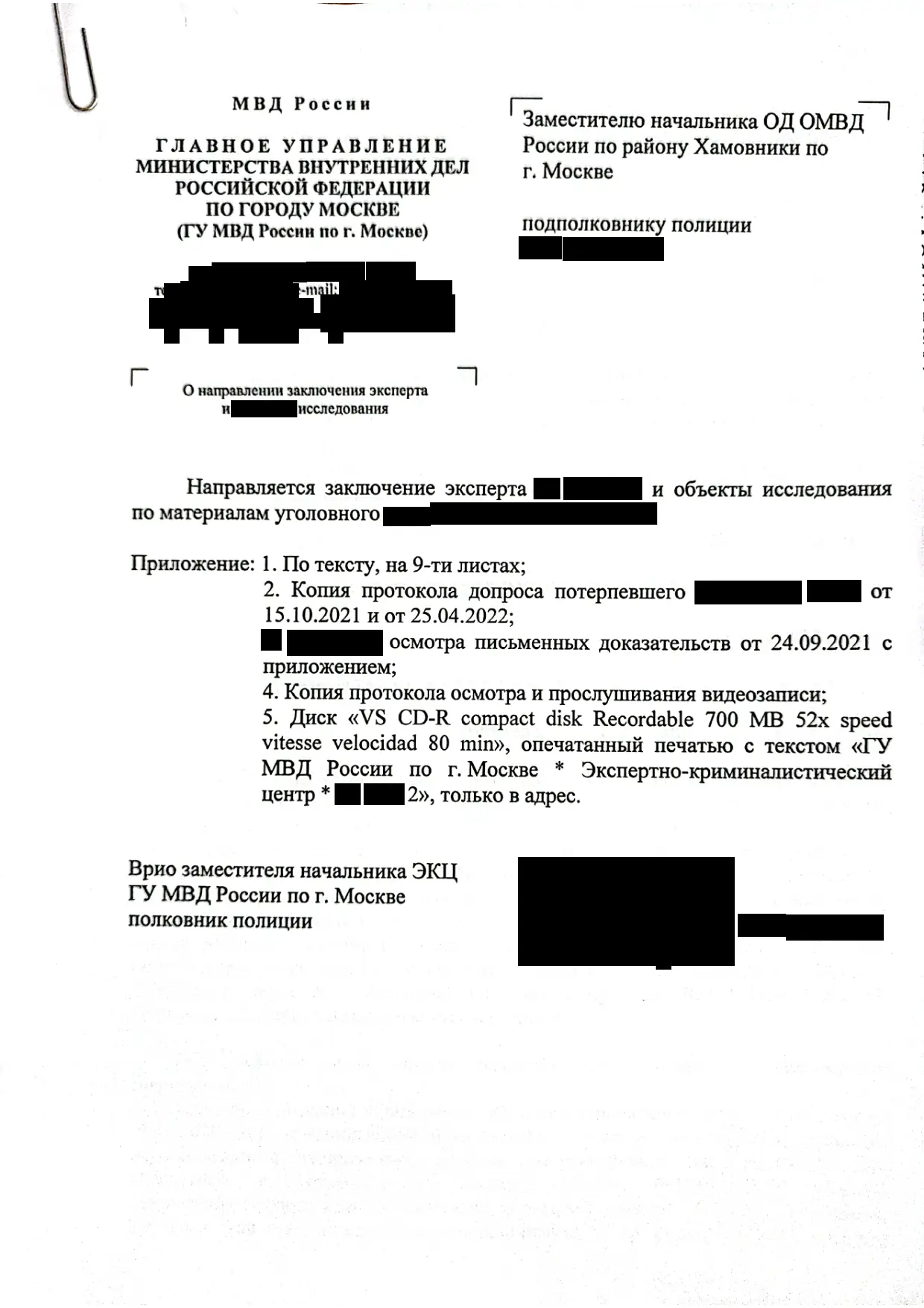
МВД России
ГЛАВНОЕ УПРАВЛЕНИЕ
МИНИСТЕРСТВА ВНУТРЕННИХ ДЕЛ
РОССИЙСКОЙ ФЕДЕРАЦИИ
ПО ГОРОДУ МОСКВЕ
(ГУ МВД России по г. москве)
[скрыто][скрыто]
тел.[скрыто], e-mai1: [скрыто]
О направлении заклочения эксперта
и [скрыто] исследования
Заместителю начальника ОД
России по району Хамовники по
г. Москве
подполковнику полиции
[скрыто] [скрыто]
Направляется заключение эксперта [скрыто] и объекты исследования
по материалам уголовного [скрыто]
Приложение: 1. По тексту, на 9-ти листах;
2. Копия протокола допроса потерпевшего [скрыто] [скрыто] от
15.10.2021 и от 25.04.2022;
[скрыто] [скрыто] осмотра письменных доказательств от 24.09.2021 с
приложением;
4. Копия протокола осмотра и прослушивания видеозаписи;
5. Диск «VS CD-R compact disk Recordable 700 N'IB 52х speed
vitesse velocidad 80 min», опечатанный печатью с текстом «ГУ
ОД России по г. Москве * Экспертно-криминалистический
центр * [скрыто] 2», только в адрес.
Врио заместителя начальника ЭЩ
ГУ МВД России по г. Москве
полковник полиции
[скрыто] [скрыто]
2
отп. 2 экз.
I — в адрес
2- вделоЭЩ
исп. [скрыто] [скрыто]
[скрыто]
30.06.2022
3
МВД РОССИИ
ГЛАВНОЕ УПРАВЛЕНИЕ МИНИСТЕРСТВА ВНУТРЕННИХ ДЕЛ
Российской ФЕДЕРАЦИИ
по г. Москве
ЭКСПЕРТНО-КРИМИНАЛИСТИЧЕСКИЙ
ЦЕНТР
г. Москва, [скрыто]
ПОДПИСКА
тел.[скрыто]
Мне, [скрыто] [скрыто] [скрыто], в соответствии со ст. 14 Федерального
закона от 31 мая 2001 г. У27З-ФЗ «О государственной судебно-экспертной
деятельности в Российской Федерации» разъяснены права и (Оанности эксперта,
прещтсмотренные ст. 16, 17 указанного выше Закона.
При поручении производства экспертизы об
ложного заключения по ст. 307 УК РФ предупрежд
« 6» мая 2022 года
ЗАКЛЮЧЕНИЕ ЭКСПЕР
г. Москва
дачу заведомо
2 12/5 ? а
.[скрыто] [скрыто]
2
212 -101
» июня 2022 года
Производство экспертизы начато в /ь“ч МО мин
К » мая 2022 г.
окончено в ч ДО мин « Э О
» тоня 2022 г.
Я, эксперт (специалист) отдела фоноскопических и лингвистических экспертиз
ЭКЦ ГУ РОД России по г. [скрыто] [скрыто] [скрыто], имеющая высшее
филологическое образование (специальность «русский язык и литература»), высшее
юридическое образование (специальность «юриспруденция») и стаж работы по
экспертным специальностям (идентификация лиц по фонотраммам речи; техническое
исследование фонограмм; исследование текста в целях решения вопросов смыслового
понимания) девятнадцать лет, на основании постановления о назначении
лингвиугической судебной экспертизы, вынесенного 26 апреля 2022 года
заместителем начальника ОД отдела по району Хамовники г. Москвы
майором полиции А,[скрыто] [скрыто] по уголовному [скрыто][скрыто],
произвела судебную лингвистическую экспертизу,
Обстоятельства дела /текст приведён без изменения с некоторыми
сокращениями/•.
«Органами дознания установлено, что в неустановленное время, но не позднее
27.12.2020 года, неустановленное лицо, находясь в неустановленном месте, используя
неустановленные технические средства, распро анндо п-у—жсоциальной сети
«Facebook» на странице с именем «М нович» публично
демонстрируюицуюся статью, содержащуао завед ожные с едения, порочащие
честь и достоинство, а также подрывающие репут его Ю.С., который
2
4
2
впервые обнаружил 27.12.2020 в неустановленном точно дознанием месте, в связи с
чем IP. [скрыто] Ю.С. обратился в России по району Хамовники г. Москвы
по адресу г. Москва, [скрыто][скрыто]
Допрошенный в качестве потерпевшего [скрыто] сообщил, что в декабре 2020
Арцинович распространил в сети интернет на своей личной странице с именем
«[скрыто] Арцинович» в социальной сети «Factbook» (Фейсбук) порочащие в
отношении него заведомо ложные сведения, а именно назвал преступником,
возглавляющим организованную преступную группу, совершающую тяжкие и особо
тяжкие преступления - «Этот криминальный бизнес сколотил организованную
преступную группу (ОПС) состоящую из своего племянника [скрыто] [скрыто],
своей бухгалтерши Лодмилы [скрыто], водителя [скрыто] и еще нескольких
участников»; «Рекет , вымогательство и рейдерство - для [скрыто] обычная
практика»; «у него в Испании проходят постоянные встречи с криминальными
лидерами преступного мира России и стран ближнего зарубежья»; «на самом деле он
обычный преступник, который заработал больше 100млн долларов на контрабанде»;
«он отмывал десятки миллионов долларов черв банки Цюриха, Дубая, ГонКонга,
Сингапура»; «уже тогда подав на меня иск в суд [скрыто] и вся его команда
совершили как минимум два уголовных преступления покушения на мошенничество
в особо крупном размере группой лиц и дача заведомо ложных показаний в суде». В
своем допросе [скрыто] сообщает, что данные статьи с Фейсбука ему стали
приходить на телефон в вацапе от общих друзей с конца декабря 2020 года до августа
2021. После написания заявления в ОМВД России по району Хамовники г. Москвы
данные статьи были удалены. У [скрыто] имеются лишь снимки этих угатей с
экрана телефона.
Таюке в сентябре 2021 от друзей Потцкий получил ссылку на видеоканал [скрыто]
[скрыто], где было представлено несколько видео в формате интервью. Данные
видео были сохранены [скрыто] путем обращения к нотариусу, который лично
зашел на канал [скрыто] Арциновича, просмотрел видео и скопировал на диск.
Данный диск ОД ОХТВД России по району Хамовники г. Москвы просмотрен,
составлен протокол осмотра и прослушивания видеозаписи.».
В распоряжение эксперта предоставлено [текст приведён без изменения/:
«- настоящее постановление;
- копию протокол допроса потерпевшего [скрыто] [скрыто] от 15.10.2021 и от
25.04.2022; - протокол осмотра письменных доказательств от 24.09.2021 с приложением;
- копию протокола осмотра и прослушивания видеозаписи
- CD-R compact disk Recordable 700 МВ 52х speed vitesse velocidad 80
min».
Перед экспертом поставлен следующий вопрос /вопрос приведен без изменения/:
«- Имеются ли в представленном видеоматериале высказывания, в которых
получили выражения какие-либо факты действительности или положение дел,
имеющие отношение к [скрыто] [скрыто] [скрыто] и выражающие негативную
оценку его личности и деятельности? Если имеются, то, _$акођ Дорме? Имеется ли
ссылка на какой-либо источник информации?»
12/5
2
5
З
Осмотр предоставленных на экспертизу матерналов н нх описанне
Материалы поступили на исследование 16 мая 2022 года в неупакованном и
упакованном виде.
Предоставлены:
• протокол осмотра письменных доказательств от 24.09.2021 года на двух листах
4юрмата А4 с печатным текстом с обеих сторон с приложением на 10-ти листах. По
левому верхнему краю имеется сквозное отверстие диаметром примерно 05 мм.
Листн прошитн тесьмой краснот ппета. [а последнем листе концы тесьмы оклеены
отрезком материала краснот цвета, опечатанные оттиском круглой печати.
выполненным красителем синеш ипста. с частично читаемым текстом «НОТАРИУС
ЯКУБ.. НОТАРИАЛЬН„. Г. М имекпся (птиск ппампа, выполненный
краситслсм снистм нвста. рукописный текст. пыполнснный красвгтелем фиолетового
тоста. «ВСЕТ ПРОШНУРОВАНО, ПРОНУМЕРОВАНО И СКРЕПЛЕНО
ПЕЧАТЬЮ ЛИСТОВ +1 CD.R диск. ВРИО НОТАРИУСА
Т.О. ЯКУБОВОЙ Т.Н. ЛИТВИНОВА», одна подпись. выполненная крастелем
фиолетотютхэ цвета, от имени [скрыто] [скрыто] [скрыто] втором листе пртокола имеегся
одна подпись, выполненная красителем синего цвета, от имени [скрыто] ДА. Второй
лист протокола заверен одной подписью, выполненной красителем фиолетового
цвета, одним оттиском печати, выполненным краспелем синего цвета, с частично
читаемым текстом «НОТАРИУС Т.О. ЯКУБОВА * НО..ЛЬНЫЙ ОКРУГ ... Г.
М(ИВА * ...». К протоколу прилагается приложение на 9-ти листах формата А4 с
изображениями с одной стороны. На 9-ом листе имеются одна подпись, выполненная
чтителем синего цвета, от имени [скрыто] [скрыто], одна подпись, выполненная
нуасителем синего цвета, один оттиск круглой печати, выполненный красителем
синего цвета, с частично читаемым текстом «НОТАРИУС Т.О. ЯКУБОВА *
НОТАРИАЛЬНЫЙ ОКРУГ: Г. МОСКВА * ...».
В приложение вшит конверт из бумаги белого цвета размером примерно
325х229мм. На клапане конверта имеются сопроводительная надпись, выполненная
рукописным способом красящим веществом синего цвета: ”Приложение 7», огтиск
уруглой гербовой печати, выполненный красящим веществом синего цвета, с
частично читаемым текстом: ”...Т О ЯКУБОВА * ...Й ОКРУГ Г. МОСКВА* ... ».
Клапан конверта оклеен полсмой бумаги белого цвета, на которой имеются
сопроводительная надпись, выполненная рукописным способом красящим веществом
синего цвета, с частично читаемым текстом: «осмотрено Зам. начальника ОД
России Хамовники СИ», одна подпись. Клапан оклеен липкой лентой типа скотч.
При вскрытии конверта из него был извлечен один диск.
Диск — утандартный компакт-диск CD-R с поверхностью желтого цвета. На
нерабочей [10BepxJIWTJI диска имеются надписи: «VS CD-R СОМРАСТ disc
Recordable 700МВ 80MIN Title Date Content», выполненные заводским способом.
Вокруг посадочного кольца диска 2 имеются слабо разборчивые номера, читаемые
экспертом как: [скрыто]
- копия протокола допроса потерпевшего от 15 октября 2021 года на двух
нескрепленных между собой ЛИСТАХ формата А4 с печатным текстом с одной
стороны. Каждый лист заверен одним оттиском штампа, выполненным красителем
синего цвета, «КОПИЯ», одним оттиском круглой е4атЦ}фђјполненным красителем
'eiiit-4gy России по г.
синего цвета, с частично читаемым текстом <
Москве * УВД по ЦАО ГУ ТОД России по г.. Отдел N•fB России по району
Хамовники г. Москвы [скрыто][скрыто]»;
[скрыто]
2
6
4
- копия дополнительно допроса потерпевшего от 25 апреля 2022 года на двух
нескрепленных между собой листах формата А4 с печатным текстом с одной
стороны. Каждый лист заверен одним оттиском штампа, выполненным красителем
синего цвета, «КОПИЯ», одним оттиском круглой печати, выполненным красителем
синего цвета, с частично читаемым текстом «МВД России *ГУ МВД России по г.
Москве * УВД по ЦАО ГУ МВД России по г. ...
- Огдел МВД России по району
Хамовники г. Москвы [скрыто][скрыто]»;
- копия протокола (Ю,зотра и прослушивания видсшаписи (п 26 апреля 2()22 года
на 18-ти нескрепленных между собой листах формата Л4 с печатным текстом и
изображениями с одной стороны. Каждый лист завсрсн одтшм сггиском штампа,
выполненным красителем синет цвета, «КОПИЯ», одним штиском круглой печати,
выполненным красителем синего цвета, «МВД России * ГУ МВД России по г. Москве
- УВД по ЦАО ГУ МВД России по г. ...$ * Отдел МВД России по району Хамовники
г. Москвы [скрыто][скрыто]».
ИССЛЕДОВАТЕЛЬСКАЯ ЧАСТЬ
Решение вопрос.а проводилось в соответствии с типовой методикой
судебной лингвистической экспертизы, утверждённой методическим советом ЭЩ
ХОД России в 2008 году, и методическими рекомендациями «Лингвистическая
экспертиза текстов, ограниченно пригодных для исследования», утверждёнными на
заседании расширенного состава научно-практической сещии ЭЩ ГОД России в
2019 ГОЂ'. экспертом использовалось информационное письмо ЭКЦ
России «Об особенностях проведения лингвистического исследования материалов,
распрстраняемых с использованием информационно-телекоммуникационных
технологий, а также сети Интернет и содержащих признаки, соотносимые с
преступлениями и правонарушениями, предусмотренными ст.207.1 УК РФ и ч.З ст.
20.1 КоАПРФ» ([скрыто] от 28.10.2021 г.).
При решении поставленного вопроса использовалось типовое рабочее место
эксперта, в состав которого входят:
[скрыто]
обеспечением;
- специальное программное обеспечение для производства лингвистической
экспертизы («ИСТА-Сисгемс»); - стереоусилитель типа STR-[скрыто] («SONY»);
- головные стереотелефоны типа [скрыто] («AkG»);
- принтер «НР Laser Jet [скрыто]»,
Методическая и справочная литература:
- [скрыто] О,[скрыто] [скрыто] лингвистических терминов, Изд. 3-е, стереотипное. —
м., 2005.
Словари: - [скрыто] [скрыто] [скрыто]-словообразовательный орарь русского языка. В
2 т. - М., 2000.
,zoC' - [скрыто] [скрыто] [скрыто] словарь ненорманн [лекси>русского языка.—
м., 2003.
Мо /
- -м., 2066
- [скрыто] [скрыто] [скрыто] словарь иноязычных
7
5
5. [скрыто] [скрыто] [скрыто] толковый словарь русского языка. — Спб., 2002.
6. [скрыто] [скрыто], [скрыто] [скрыто] [скрыто] словарь современного русского
языка. — М., 2011.
7. [скрыто] [скрыто] [скрыто] сокращений современного русского языка. —
м.,2006.
8. [скрыто] [скрыто] [скрыто] слова и их значения в современных газетных текстах
(Краткий словарь-справочник) — Гомель, 2012.
9. [скрыто] [скрыто] [скрыто] новейший толковый словарь русского языка XXI века —
м., 2011.
10. [скрыто] [скрыто] [скрыто] словарь русской разговорной экспрессивной речи. —
СПб., 2004.
В процессе исследования и оформления заключения могут исполыоваться
следтющие термины и определения:
Адресант — субъект речи, говорящий, центральная категория прагматиют,
обуславливающая и организующая все составляющие коммуникативных процессов.
воспринимающий сообщение, слушающий или читающий;
А Дресат
центральная категория прагматики.
Высказывание в форме утвержДения о факте
высказывание,
пропозициональный компонент которого соотносится с действительностью
Высказывание в форме некатегоричного утвержДения о факте — высказывание,
пропозщиональный компонент которого соотносится с действительностью
опосредованно через категорию авторизации. Некатегоричные утверждения могут
быть выражены при помощи маркеров авторизации:
- конструкции «существительное (местоимение) со значением лица» + глагол со
значением мышления / говорения (считать, щмать, знать, предполагать, говорить и
т.п.); - вводные слова, соотносящие содержание утверждения с источником
сообщаемого.
утверждение о факте может не иметь маркеров авторизации, а
получает значение некатегоричного утверждения из контекста.
Коммуникативная ситуация — конкретная ситуация общения, в которую входят
партнеры по коммуникации, условия и способы реализации коммуникативной задачи.
Коннотация — эмоциональная оценочная или стилистическая окраска языковой
единицы.
Контекст — обладающая смысловой завершенностью устная или письменная
речь, позволяющая выяснить смысл и значение отдельных входящих в её состав
фрагментов (слов, выражений или отрывков текста).
Лексема — слово как структурный элемент языка.
Модальность — функционально-семантическая категория, выражающая разные
виды отношения высказывания к действительности (объективная модальность: «люди
счастливы — люди были счастливы, люди будут счастливы — люди были бы счастливы
— пусть люди будут счастливы»), а также разные виды субъективной квалификации
сообщаемого (субъективная модальность: «люди, конечно, счастливы —
люди,
вероятно, счастливы — во-первых, люди различными
формы наклонения,
грамматическими и лексическими средствами,
модальные глаголы, интонация и т.п.
32/5
2
8
Оценка (категория оценки)
совокупность разноуровневых единиц,
объединенных оценочной семантикой и выражающих положительное или
отрицательное отношение автора к содержанию речи. Оценка характеризуется особой
структурой — модальной рамкой, которая накладывается на высказывание и не
совпадает ни с его логико-семантическим, ни с синтаксическим построением.
Элементами оценочной модальной рамки являются субъект и объект, связанные
оценочным предикатом. Субъект оценки (эксплицитный или имплицитный) — это
лицо, или социум, с точки зрения которого дается оценка; объект оценки — это лицо,
предмет, событие или положение вещей, к которым относится оценка. Кроме того, в
модальную рамку входят (как правило, имплицитно) шкала оценок и стереотипы, на
которые ориентирована оценка в социальных представлениях коммуникантов.
ПреДположение
высказывание, выражающее неуверенность, сомнение,
вероятность того или иного события, одну из ряда возможных версий («может быть,
это они»; «вероятно, это произошло вчера»).
Пресуппозиция — компонент общих знаний адресата и адресанта.
Пропозиция — совокупность номинаций, отдельных ситуаций, отвлеченных от
мода-льного содержания. В состав пропозиции входят предикат, способный
приобретать модальные и временные характеристики, и термы, которые являются
логическим соответствием понятию актантов.
Села — минимальный компонент значения слова.
Утверждение — высказывание, в котором утверждается что-либо и в котором
отображается связь предмета и его признаков. Грамматически утверждение
выражается формой повествовательного предложения — как невосклицательного, так
и восюшцательного. Утверждение может содержать слова и словосочетания,
подчеркивающие достоверность сообщаемого. («Это действительно он. Это он.
Конечно, это он»).
Целеустановка — языковой способ представления, организации информации
адресантом (говорящим), имеющий целью тот или иной вид воздействия на адресата,
и как тшшчного его представителя — слушающего (вопрос, требование, просьба,
совет, предложение, угроза, предостережение, возражение, подтверждение и т. д.).
Факт
событие, происшествие или явление,
существовавшее или
существующее в действительности. Важно различать факт и комментарии по поводу
факта, то есть высказывания о факте. Предметом исследования эксперта-лингвиста
является высказывание о факте, но не факт.
Экстицитный — выраженный с помощью языковых средств, специально
предназначенных для данного выражения. Противопоставлен шипаицитному —
выраженному косвенно, в скрытой форме.
Ниже приняты следующие условные обозначения:
- сноски на литературные источники в тексте экспертного заключения даны в
квадратных скобках, внутри которых указан порядковый номер источника в списке
литературы; - курсивом выделены словарные дефиниции;
- шрифтом меньшего размера выделены цитируемые фрагменты спорного
текста; - кушоры при цитировании обозначены значком . (4. ,.
- подчеркиванием в цитируемых фрагментах Кыд ены компоненты текста, на
которых акцентируется внимание при анализе;
2
9
7
- орфография и пунктуация в цитируемых фрагментах сохранена.
Установление объектов исследования
С целью установления объектов, имеющих тгношение к предмету исследования,
экспертом проведено ознакомление с содержанием предоставленных материалов. В
результате установлено следующее.
СТ 1 содержится на представленном диске в файле «Встреча с другом [скрыто]
[скрыто]. Джентельменское соглашение с Пспоцким.тр4». Начинается примерно
через 00 минут 13 секунд словами: «Ко мне они пришли нищебродами» и
заканчивается словами: «Москва, 2021 ».
Длительность СТ 1 примерно 17 минут 14 секунд.
СТ2 содержится на представленном диске в файле «Криминал и бандиты XXI
века. Утроза жизни Арциновича.тр4». Начинается примерно через 00 минут 00
секунд словами: «Они дали ложные показания» и заканчивается словами: «Москва,
2021».
Длительность СТ2 примерно 29 минут 48 секунд.
СТЗ содержится на представленном диске в файле «Смерть [скрыто] [скрыто].
Дело «Росморавиа». Магия харизмы [скрыто]..тр4». Начинается примерно через
00 минут 14 секунд словами: «Люди заработали на контрабанде» и заканчивается
словами: «Москва, 2021».
Длительность СТЗ примерно 22 минуты 45 секунд.
Иные файлы на представленном диске отсутствуют.
Описание объектов исследования и определение их пригодности
для проведения лингвистических исследований
СТ 1 — СТЗ реализованы в жанре интервью.
Интервью — нескл. ср. L ПреДназначенная Для распространения в среДствах
массовой информации бесеДа с каким-либо лицом в форме вопросов и ответов на
представляющие общественный интерес темы [1].
СТ1 — СТЗ представляют собой сложные тексты, включающие в себя следующие
компоненты: - звучащий вербальный (речь на русском языке);
- визуально-вербальный (заголовок, комментарии к фотоизображениям и
тематически связанные с устным текстом простые письменные тексты, оформленные
как вставки, цитаты, титры); - визуальный (фотографии);
- звучащий невербальный (звуковое сопровождение к письменным и устным
текстам: музыка, звуковые эффекты).
Между звучащим вербальным и визуально-вербальным компонентами не
установлены отношения взаимодополнения. Визуально-вербальные компоненты
оформляют подачу информации, выполняют иллюстративную функцшо. Таким
образом, СТ 1 — СТЗ являются комбинированными текстами
Изложение материала в звучащем (устные тексты)
представлено в диалогической, вопросно-ответно
[скрыто]
2
10
8
Интервьюер беседует с лицом, именуемым как «ARTSINOVICH», «[скрыто]
Арцинович основатель Британского ювелирного бренда MAXIMILIAN-LONDON
Коллекционер, меценат, зоопроповедник».
Способ общения коммуникантов между собой кот-актный, визуальный, с
интернет-аудиторией — дистантный, опосредованный.
В границах СТ 1 — СТЗ имсются участки, на которых «гмечено ухудшение
восприятия некоторых слов и фраз, что можег быть объяснено особенностями
артикуляции говорящих или условиями записи. Отмеченное снижение разборчивости
на отдельных участках не влияст на смысловое понимание речевой информации в
реплики собеседников
целом, удовлетворительно
прослушиваемые
взаимообусловлены по смыслу, на интонационном уровне соответствуют
коммуникативной ситуации.
Письменные тексты в CTl — СТЗ реализованы на русском языке, графически
оформлены с помощью заглавных и прописных букв кириллического алфавита с
элементами латиницы («Сила — в правде, у кого правда, тот и сильный!» - СТ1-СТЗ;
«[скрыто] Арцинович основатель Британского ювелирного бренда MAXIMILIAN-
LONDON Коллекционер, меценат, зоопроповедник» - СТ2, СТЗ, «Москва. [скрыто]
[скрыто] против [скрыто] Арциновича» - СТ2). Печатный шрифт разборчив,
доступен для восприятия и понимания.
В СТ 1 — [скрыто]людается использование цифр: «2021».
СТЗ как пригодные
Данные характеристики позволяют оценить СТ 1 —
для лингвистического анализа.
Определение лингвистических характеристик текста
Анатшз лингвистических характеристик представленных на исследование текстов
показал следующее.
СТ 1 — СТЗ размещены на интернет-ресурсе, что является признаком их
интерпернальной направленности, доступности для неограниченного количества
СТ 1 — СТЗ обладают смысловой, логической, формально-грамматической
связанностью языковых единиц, являются цельными. Имеют ситуационно
начало и завершение, развитие темы происходит последовательно,
мшфотемы распределены в соответствии с коммуникативным заданием, реализуемым
адресантом на протяжении текстов.
Общая тема для СТ1 — СТЗ — деятельность [скрыто]. Целеустановка —
информирование о событиях и людях, доведение оценочной информации о [скрыто]
и иных лицах.
Таким образом, анализ лингвистических характеристик текстов показал, что
решение поставленного вопроса возможно на лингвистическом материале, доступном
для понимания.
С учетом специфики актуализации лексического, синтаксико-семантического,
стилистического, формально-логического уровней устного текста, были выбраны
методы анализа предоставленных материалов:
- аудитивный перцептивный анализ;
70 ' - визуальный перцептивный анализ;
- концептуальный анализ (определение вербальныч, едставитедей ключевого
понятия для интерпретации смысла текста);
2
11
9
- анализ структурной организации текста (выявление и описание структурных
единиц текста, их границ и способов оформления, характеристика целостности и
связности текста); - лексико-семантический и семантико-синтаксический анализ (определение
значения слов, словосочетаний, предложений в контексте высказывания и
сверхфразового единства); - трамматический анализ предложений (определение грамматического значения
слов); - ана.лиз пропозиций, или логико-грамматический анализ (определение
логической основы семантической структуры предложения); - анализ пресуппозиций (определение общего компонента знаний для участников
коммуникации); - компонентный анализ слова (определение семного состава слова);
- функционально-прагматический анализ (характеристика иллокутивной
функции высказывания и определение типа речевого акта); - риторический анализ, или анализ аргументативного компонента текста
(выявление составляющих аргументативной структуры текста — обоснования); - метод интерпретации и обобщения;
- гипотетико-дедуктивный метод.
Решение поставленного вопроса
Решение вопроса проводилось поэтапно по тексту.
- Анализ коммуникативной ситуации (определение адресата, адресанта, канала
связи). - Выявление структурных компонентов оценки (субъект, объект, шкала оценок
и стереотипы).
[скрыто] [скрыто] слов и высказываний, в которых даётся оценка объекту;
проведение семакгико-синтаксического анализа данных высказываний, лексико-
семантического, лингвостилистического и компонентного анализ слов, несущих
оценку, на предмет определения негативного или позитивного значения и
стилистических характеристик. - Определение формы подачи информации (утверждение, некатегорическое
утверждение, предположение, оценочное суждение). - Выявление ссылок на источник информации.
Адресант — лицо (лица), создавшее (-ие) тексты и разметившее (-ие) их на
интернет-ресурсе, именуемое как «ARTSINOVICH», «[скрыто] Арцинович основатель
Британского ювелирного бренда MAXIMILIAN-LONDON Коллекционер, меценат,
зоопроповедник».
Адресат — неопределённый круг лиц, имеющих доступ к СТ 1 — СТЗ.
Тексты, размещённые в сети Интернет, приобретают признаки
интерперсональной направленности.
Субъект оценки — это лицо или группа лиц, с точки зрения которого (которой)
дается оценка. В исследуемых текстах субъектом оценкц_является лщо, именуемое
как «ARTSINOVICH», «[скрыто] Арцинович основутёЯь' Б)нтанского ювелирного
бренда MAXIMILIAN-LONDON Коллекционер, мецеЙћ? оопрбТ1 ведник».
N2 •iZ”5
2
12
10
Объект оценки — это лица, предметы, события или положение вещей, к которым
относится оценка. Объектом оценки являются «[скрыто] По-гоцкий», «Юра»,
«[скрыто]», согласно данным в постановлении — [скрыто] [скрыто].
Методами
лексико-семантического,
и
семантико-синтаксического
компонентного анализа устанавливалось наличие или отсутствие отрицательно-
оценочного компонента в структуре ссмагггики высказывания, относящегося к
[скрыто] [скрыто]
[скрыто] оценки всегда представляет собоИ рационально-оценочную
коннотацию, известную носителям языка из общечеловеческого или национального
опыта, типа: хорошо — плохо.
В СТ 1 критериям поиска соответствует следующие высказывания:
- «У [скрыто] и у [скрыто] у них был бизнес, у них была финансовая компания, которая
занималась скупкой ваучед там приватизацией, покупкой ащий, облигаций и ещё что-то. Такая
финансовая компания — стрелки, разборки, туда-сюда. Девяностые. Мне, конечно, Серёжа много
рассказывшт всего интчтного, что у них там криминал. бандиты. сл»дки, стрлки, туда-сюда,
тамбовские, малышевские, чеченцы. <...> [скрыто] полностью кинул Кисел?ц, раздел его просто ну
вот до гола». - «<...> Юра не был в таможне никогда, то он занимался вот этими своими там аферами,
МЗЫЩЩЩЯМЦ, финансами в Петербурге<...>».
З. «Ко мне они пришли ццщ$ррддмц, а стали этой знаменательной встречи очень
богатыми людьми».
Субъект оценют — лицо, именуемое как «ARTSINOVICH».
Объект оценки — лицо, «[скрыто]», «Юра», представленный
эксплицитно; также представленный в высказываниях 1, 3 в ряду лиц. В
высказываниях 2 З используются анафорические местоимения «он»,
из контекста как «Юра»; «у них», восстанавливается из контекста
как «[скрыто]» и «[скрыто]», «они», восстанавливается из контекста как «Юра» и
«Саша».
Для выражения негативной оценки использованы высказывания, содержащие
описание действий [скрыто]: «юшул на деньги партера по бизнесу [скрыто]»,
«занимался аферами, махинациями»; прямое наименование «нищеброд».
На основе пропозиционального анализа с учётом пресуппозиций определено:
[скрыто] занимался криминалом, стрелками, встречами с бандитами, жульничеством
и мошенничеством, кинул своего партнера по бизнесу и был нищим человеком до
встречи с Ромой [скрыто].
То, в чем есть признаки преступления; уголовное дело.
Криминал - 1. - Что-либо преДосуДительное, выхоДящее за преДелы общепринятых норм
повеДения и потому заслуживающее порицания.
Им. Уголовная среда; дреступники. [2]
м. 1. Член банды (банда 1 1.) или бандгруппировки,
БанДит -
совершающий разбойные нападения; вооруженный грабитель. - разг. Тот, кто виновен в каких-либо преступлениях
террористической
II м. разг. Член
вооруженной
националистической - группировки; боевик I. [2]
обычно
Стрелка - жара Вст ча бандитски
о выяснё}щя отношений,
ивобтояни вооруженных
совершения сделок(обычно крайне напряженная, с
участников); всякая встреча, любое свидание. [10]
Кидать — жарг. 6.06манывать, не возвращать в
2
13
11
Афера - Недобросовестное, мошенническое предприятие, дело, Действие. [4]
Махинация - неоДобр. Интрига, нечестная проделка, жульничество. [4]
Для выражения негативной оценки объекта используется сообщение,
содержащее оценочную лексему: «нищеброд».
НищеброД- устар. Нищий бродяга. [2]
1, Употребляется
Очень -
нареч. качеств.-количеств.
усилитель неопределенно большого количества кого-либо или чего-либо. [2]
как
- Владеющий значительными материальными
Богатый -
ценностями и Денежными средствами. [2]
Определено, [скрыто] занимался чем-то предосудительным, жульничеством и
мошенничеством, участвовал во встречах бандитских труппировок, обманул своего
партнера по бизнесу и был нищим человеком до встречи с Ромой [скрыто].
Данные положения дел характеризуют деятельность лица, именуемого как
«[скрыто]», для характеристики используется лексика с нейтральной семантикой.
Исследуемые слова в данном контексте имеют отрицательную коннотацию,
специальные пометы и являются средством выражения негативной оценки действий
лица, именуемого «[скрыто]».
Таким образом, в СТ 1 имеются высказывания, в которых содержится
негативная оценка [скрыто] [скрыто], его действий.
В СТ2 критериям поиска соответствуют следщющие высказывания: - «<...> то есть вот эти мошешпжи. воры и проходимцы стали богатыми людьми, ну, потому
что я их привёл туда, куда надо<...>»; - «<...>То есть были его деньги грязные, у меня нормальный, чистый бизнес, да, были его
деньги грязные, они висели на офшорах, ну и как бы мы его бабки с офшш)в прокрутили чеЕЕ3 свои
компании<...>»;
З. «<...>И я взял у этого козла, потому что можно было взять у кого угодно, но я взял у него,
потому что он постоянно находился на моей орбите<. ..>»; - «<...> человек всю жизнь занимается контрабандой прфессионально»;
- «<...>Хотя он два миллиона он не.давал по контракту. И вот эти деньги, которые он как бы
нам давал, мы ему как бы вернули, а вот эти деньги один миллион сто семьдесят семь тысяч сто
тридцать четыр они нам дали наличными в Москве и на это есть расписка. Вот это есть
мошенничсгво<.. .>»; - «<...>То есть до меня было шесть аналогичных случаев, когда они давали компаниям деньги,
владельцы компаний давали поручительство в виде личной расписки, и после этого они
обращались в суд, когда им возвращали уже деньги, и получали по расписке эти деньги. То есть это - дело в том, что [скрыто] — он прямо дримищчљный, у него бандипжая романтика,
она в жопе играет очень - «<.,.>Я по закону смогу доказать, что он и его компания — это угод_щщц, которые
совершили в отношении меня уголовное
Во всех исследуемых фрагментах субъект оценки — адресант, именуемый как
«[скрыто] Арцинович основатель Британского ювелирного бренда MAXIMILIAN-
LONDON Коллекционер, меценат, зоопроповедник».
Объект оцени — лицо, именуемое «[скрыто] Нредёт*енцый в ряду' лиц в
высказываниях 1, 6, 8 (использованы местоим ия множ енного числа эти,
глаголы совместного действия множественного чи
2
14
12
Для выражения негативной оценки использованы высказывания, содержащие
описание действий [скрыто]: «занимался контабандой»;
содержащие
характеристику его деятельности «грязные деньги»; прямые наименования:
«мошенник», «вор», «проходимец», «козел», «уголовник».
На основе пропозиционального анализа с учётом пресуппозиций определено:
[скрыто] занимается мошенничеством, контабандой и рейдерством, состоит в
организованной преступной [руппе, имея грязные деньги.
Грязный — 5. Основанный на использовании предосудительных приемов и
среДств; преслеДующиЙ неблаговиДные цели (о Делах в поступках). Г-ые Делишки,
махинации. Г-ая спекуляция. Политика — слишком грязное ремесло! Г-ые Деньги
фазг.; Добытые нечестным путем). [5]
Добывать - 1.
Получать, приобретать что-либо, пршюжив усилия,
старание.
// Приобретать труДом; зарабатывать. [2]
Нечестный — Лишенный четности, поряДочности; бесчестный. [5]
Офшор — Финансовый центр, компания, привлекающая иностранный капитал,
не контрдџщеуый на территории своей страны: центр совместного
преДпрцншмательства финансистов разных стран. [6]
Контрабанда - 1. ТайныЙ беспоиццнныЙ вровоз шти перенос чего-либо через
государственную границу. [2]
Профессионшљно - нареч. качеств.-обстоят. Так, как характерно для
профессионалов. [2]
Тайный - 4. Не разрешаемый законом; подпольный, конспиративный. [2]
Мошенничество - Поведение, поступки мошенника: плутовство. [2]
Плутовство - 1. Хитрый и ловкий обман; мошенничество. [2]
Рейдер — Тот, кто занимается рейдерством по своей инициативе или по заказу
со стороны [9]
Рейдерство Неол. — * Поглощение предприятия против воли его собственника
или руководителя [8]
Рейдерство — Стовое неДружественно поглощение предприятия против воли
его собственника, имеющего преимущественное положение в Данном преДприятии,
тили руководителя [9]
ОПГ- Организованная преступная группа.» [7]
Уголовник - I м. разг.
Уголовный преступник, [2]
Престутение - L Общественно-опасное Действие гии безДействие,
направленное против существующего строя иди нарушающее существующий
правопоряДок.
2. перен. НеДопустииыЙ, непозволительный поступок. [2]
Для выражения негативной оценки объекта используются сообщения,
содержащие оценочные лексемы: «вор», «мошенник», «проходимец», «козел»,
«криминальный», «уголовник».
Мошенник — Тот, кто обманывает других в корыстных целях; тут. [2]
Вор- 1.
Тот, кто занимается воровством. совершает,кражт. [2]
Проходимец — Им. разг.-сниж. Плут, мошенник п2дЙд0хи”'
Пройдоха - разг.-сниж. Тот, кто пронырлив,
ощт„• врдн ра. [2]
2
15
13
Козел - 1. разг.-сниж. Упрямый, неприятный в общении человек.
2. Употребляется как порицающее гии бранное слово. [2]
Криминальный - 1. Преступный, уголовный. [5]
СвоЙственныЙ банДиту (банДит 1), характерный Для него.
БанДитскиЙ —2.
Уголовник — уголовный преступник. [5]
Исследуемые слова в данном контексте имеют отрицательную коннотацшо,
таюке в значении слов прослеживается негативная коннотация через функциональные
пометы, ограничивающие сферу употребления данного слова — «разг.-сниж.»,
поэтому их употребление является средством выражения негативной оценки лица,
именуемого «[скрыто]».
Определено, [скрыто] обманывал других в составе группы лиц в корыстных
целях, совершал кражи, мошенничал, занимался беспошлинным провозом товара
через границу; поглощал предприятия против их воли и состоял в организованной
преступной группе, его деньги были получены нечестным путем. [скрыто]
характеризуется как человек неприятный в общении, преступный.
Данные положения дел характеризуют деятельность лица, именуемого как
«[скрыто]», для характеристики используется лексика с нейтральной семантикой.
Исследуемые слова в данном контексте имеют отрицательную коннотацию,
специальные пометы и явлшотся средством выражения негативной оценки объекта,
его действий, результатов деятельности лица, именуемого «[скрыто]».
Таким образом, в СТ2 имеются высказывания, в которых содержится
негативная оценка [скрыто] [скрыто], его действий и результатов деятельности.
В СТЗ критериям поиска соответствуют следуощие высказывания:
- он начинают ежемесячно вести по несколько сот контейнер через
северо-западную таможню<...>»; - «<...>я то знаю самого [скрыто], который мне это 1Ж)днократно рассказывал, то есть он
фактически монополизцровал рынок контрабандой через северо-западную таможню, взял под
свою крышу, то есть те, у кого были проблемы, кто ехать не мог, он их забирал под себя<...>»;
З. «<...>покупал часы компании, он такой хитровыебанныђ, такой вот, я не знаю даже как
сказать, да, и он не еврей в общем-то<...>».
Для выражения негативной оценки использованы высказывания, содержащие
описание действий [скрыто]: «занимался контабандой»; монополизировал рынок
контрабандой; прямые наименования: «хитровыебанный».
На основе пропозиционального анализа с учетом пресуппозиций определено:
[скрыто] занимается контабандой, монополизировал рынок.
Контрабанда — см. выше.
Монополизировать - 1. Осуществлять монополизацию. - Присваивать исиючительное право на осуществление чего-либо. [2]
Для выражения негативной оценки объекта используется сообщение,
содержащее оценочную лексему: «хитровыебанный».
Данное слово образовано от слияния двух слов хитрый и выебанный.
Выебанный — причастие, образованное от глагола «ебать».
Хитрый - 1. Скрывающий свои истинные наивная, 'Дей€твующий непрямым,
обманным путем; лукавый.
И Выражающий хитрость, лукавство. - Обнаруживающий скрытый умысел; ВЫЙ. 3 а
2
5
16
14
// Преисполненный Добродушного лукавства, игривости.
[скрыто] [скрыто], искусный в чем-либо; хитроумный.
4. Замысловатый, мудреный.
И Преисполненный хитроумия, изобретательности.
И Опличающийся выДумкой, секретом. [2]
Ебать — табу. 1. Совершать половой акт (о мужчине)
2. СиЛьно ругать, отчитывать кого-л.
[скрыто] [скрыто] с полным пренебрежением, презрением к кому-л.,
чему-л. [З]
Исследуемое слово в данном контексте имеет отрицательную коннотацию,
также в значении слова прослеживается негативная коннотация через
функциональные пометы, ограничивающие сферу употребления данного слова —
«табу», поэтому его употребление являдгся средством выражения негативной оценки
лица, именуемого «[скрыто]».
Определено, [скрыто] занимался беспошлинным провозом товара через
гранищ, присвоив исключительное право на рынке сбыта. [скрыто] характеризуется
как человек, скрывающий свои истинные намерения и относящийся с полным
пренебрежением.
Данные положения дел характеризуют деятельность лица, именуемого как
«[скрыто]», для характеристики используется лексика с нейтральной семантикой.
Кроме этого отмечается использование стилистически маркированной лексики.
Исследуемые слова в данном контексте имеют отрицательную коннотацшо,
специальные пометы и являются средством выражения негативной оценки действий
лица, именуемого «[скрыто]».
Таким образом, в СТЗ имеются высказывания, в которых содержится
негативная оценка [скрыто] [скрыто], его действий.
Далее определялась формы подачи информации, для чего произведен поиск
харакгерных лингвистических маркеров.
Утверждение — это высказывание, в котором утверждается что-либо и в
котором отображается связь предмета и его признаков. Грамматически утверждение
выражается формой повествовательного предложения, через показатели объективной
модальности (изъявительное наклонение).
Утверждения о фактах распознаются в тексте по отсутствию в предложении
маркированности специальными вводными конструкциями и наречиями,
выражающими неуверенность, сомнение, или по наличию маркированности
конструщиями, подчеркивающими достоверность сообщаемого (например:
«известно», «точно», «доподлинно», «без сомнения», «фактичесют» и т. п.).
Высказывание в форме некатегоричного утверждения о факте — высказывание,
пропозициональный компонент которого соотносится с действительностью
опосредованно через категорию авторизации,
Предположение в отличие от утверждения о факте содержит специальные
маркеры — слова, выражающие неуверенность, сомнение, вероятность происхождения
того или иного события, одну из ряда возможных версийАнапример: «может быть»,
«вероятно», «по-видимому», «как представляется», «дунетсидт т.Л;).
17
15
Высказывание в форме оценочного суждения
высказывание,
пропозициональный компонент которого соотносится с действительностью
опчэедованно через категорию оценки.
Высказывания 2 в СТ 1, 1, 2, 4, 5, 6, 8 в СТ2, 1, З в СТЗ представляют собой
повествовательные но нели высказывания предложения. В них отсутствуют
характерные маркеры предположения, выражающие неуверенность, сомнение,
вероятность происхождения тот или иного собьггия, одну из ряда возможных версий.
Не обнаружено лингвистичсских срсдсгв, которые бы свидетельствовали о
предварительном характрс ПРИВОДИМОЙ информации или неуверенности адресанта в
её достоверности.
Также в высказываниях 2 в СТ 1, 1, 2, 4, 5, 6, 8 в СП, 1, З в СТЗ учитывались
сле,тющне лексико-трамматическис и сематггические параметры: конкретность
информации, отнесенность действий к физическим фактам с опрделенным
пространственно-временным континуумом, распространение действий на конкретный
объект.
Следовательно, высказывания представлены в форме утверждения.
Высказывание в СТ 1 представляет собой повествовательное по цели
высказывания предложение. Пропозициональный компонент соотносится с
действительностью опосредованно через категоршо авторизации (ссылка на источник
информации): «Сережа много рассказывал <...>». Следовательно, высказывание
представлено в форме некатегоричного утверждения.
Высказывания З в СТ 1, З, 7 в СТ2, 3 в СТЗ носят оценочный характер, в них не
содержится утверждений о фактах. Для выражения негативной оценки использованы
общеупотребительные слова и устойчивые сочетания, а также стилистически
маркированной лексика. Их пропозициональный компонент ссютнштгся с
действительностью опосредованно, через отношение субъекта к ситуации и её
участникам.
Следовательно, высказывания представлены в форме оценочного суждения.
Таким образом, в тексте, зафиксированном в файле «Встреча с другом [скрыто]
[скрыто]. Джентельменское соглашение с [скрыто]», имеются высказывания, в
которых получили речевое выражение факты действительности и положение дел,
имеющие отношение к [скрыто] [скрыто] и выражающие негативную оценку его
действий (деятельности). Высказывания представлены в форме утверждения,
некатегоричного утверждения.
Также в представленном тексте высказывание, содержащее негативную
оценку [скрыто] [скрыто], представленное в форме оценочного суждения.
В тексте, зафиксированном в файле «Криминал и бандиты XXI века. Угроза
жизни Арциновича» имеются высказывания, в которых получили речевое выражение
факты действительности и положение дел, имеющие отношение к [скрыто] [скрыто] и
выражающие негативную оценку его действий (деятельности). Высказывания
представлены в форме утверждения.
Также в представленном тексте имеются ' ержащие негативную
оценку [скрыто] [скрыто], представленные в форме «ного с
ения.
2
Е:
18
16
В тексте, зафиксированном в файле «Смерть [скрыто] [скрыто]. Дело
«Росморавиа». Магия харизмы [скрыто]» имеются высказывания, в которых
получили речевое выражение факты действительности и положение дел, имеющие
отношение к [скрыто] [скрыто] и выражающие негативную оценку его действий
(деятельности). Высказывания представлены в форме утверждения.
Также в представленном тексте имеется высказывание, содержащее негативную
оценку [скрыто] [скрыто], предстввлсннос в форме оценочного суждения.
Для решения вопроса о наличии ссылок на какой-либо источник информации в
текстах проводился поиск марксров субъективной модальности,
указывающих на источник информации о сообщаемом. Также проводился поиск
формального выражения ит•ерпрстации чужой речи.
В СТ) в высказывании имеется ссылка на источник информации: «Сережа много
рассказывхл в высказываниях 2, З (СТ 1), СТ2, СТЗ ссылок на источник
информацнн не имеется.
выводы
- В видеоматериале, зафиксированном в файле «Встреча с другом [скрыто]
[скрыто]. Джентельменское соглашение с [скрыто]», имеются высказывания, в
которых получили речевое выражение факты действительности и положение дел,
имеющие отношение к [скрыто] [скрыто] и выражающие негативную оценку его
действий (деятельности). Высказывания представлены в форме утверждения,
некатегоричного утверждения.
Таюке в представленном тексте имеется высказывание, содержащее негативную
оценку [скрыто] [скрыто], представленное в форме оценочного суждения.
В представленном видеометериале в высказывании «У [скрыто] и у [скрыто] у них
был бизнес, у была финансовая компания, которая занималась скупкой ваучеров, там
приватизацией, покупкой акций, облигаций и ещё что-то. Такая финансовая компания — стрелки,
разборки, туда-сюда. Мне, конечно, Серёжа много рассказывал всего интм»сного, что у
них там криминал, бандиты, стрелки, стрелки, туда-сюда, тамбовские, малышевские, чеченцы.
[скрыто] полностью кинул [скрыто], раздел его просто ну вот до гола» имеется ссылка на
источник информации. В остальных исследуемых высказываниях ссылок на источник
информации не имеется.
В видеоматериале, зафиксированном в файле «Криминал и бандиты XXI века.
Угроза жизни Арциновича» имеются высказывания, в которых получили речевое
выражение факты действительности и положение дел, имеющие отношение к
[скрыто] [скрыто] и выражающие негативную оценку его действий (деятельности).
Высказывания представлены в форме утверждения.
Также в представленном тексте имеются высказывания, содержащие негативную
оценку [скрыто] [скрыто], представленные в форме оценочного суждения.
В исследуемых высказываниях ссылок на источник информации не имеется.
В видеоматериале, зафиксированном в файле «9мфТЬ [скрыто]. Дело
«Росморавиа». Магия харизмы [скрыто]» имеютря высказывания, в которых
получили речевое выражение факты действительностц положени дел, имеющие
2
19
17
отношение к [скрыто] [скрыто] и выражающие негативную оценку его действий
(деятельности). Высказывания представлены в форме утверждения.
Таюке в представленном тексте имеется высказывание, содержащее негативную
оценку [скрыто] [скрыто], представленное в форме оценочного суждения.
В исследуемых высказываниях ссылок на источник информации не имеется.
[скрыто]
[скрыто] [скрыто]
2 32/5
2
Unofficial translation.
Forensic linguistic expert report [скрыто] of 30 June 2022 (Forensic Science Centre of the Moscow Police)
[[PAGE 1]]
[Letterhead: MINISTRY OF [скрыто] [скрыто] OF RUSSIA — [скрыто] [скрыто] OF [скрыто] [скрыто] OF [скрыто] [скрыто] OF [скрыто] [скрыто] [скрыто] [скрыто] [скрыто] CITY OF MOSCOW, [скрыто], Moscow, 127994, tel.[скрыто], e-mail: [скрыто][скрыто]
To: the Deputy Head of the Inquiry Unit of the Internal Affairs Department of Russia for the Khamovniki District of Moscow, police lieutenant colonel [скрыто] [скрыто] [скрыто]
Re: the transmission of the expert report and of the objects of the examination
Herewith are sent expert report [скрыто] and the objects of the examination in the materials of criminal case [скрыто]
Annexes: 1. As per the text, on 9 sheets;
2. A copy of the record of the questioning of the victim Yu. [скрыто] [скрыто] of 15.10.2021 and of 25.04.2022;
3. The record of the inspection of written evidence of 24.09.2021 with its annex;
4. A copy of the record of the inspection and listening to the video recording;
5. The disc "VS CD-R compact disk Recordable 700 MB 52x speed vitesse velocidad 80 min", sealed with a seal bearing the text "Main Directorate of the Ministry of Internal Affairs of Russia for the City of Moscow * Forensic Science Centre * [скрыто] 2" — to the addressee only.
Acting Deputy Head of the Forensic Science Centre of the Main Directorate of the Ministry of Internal Affairs of Russia for the City of Moscow, police colonel — [скрыто] [скрыто] [скрыто] [signature]
[[PAGE 2]]
[Reverse side of the covering letter with the service marks: "printed in 2 copies; 1 — to the addressee; 2 — to the file of the Forensic Science Centre; drawn up by [скрыто] [скрыто] [скрыто],[скрыто], 30.06.2022".]
[[PAGE 3]]
[Letterhead: MINISTRY OF [скрыто] [скрыто] OF RUSSIA — [скрыто] [скрыто] … [скрыто] [скрыто] [скрыто] OF MOSCOW — [скрыто] [скрыто] [скрыто], Moscow, [скрыто], tel.[скрыто]]
UNDERTAKING
I, [скрыто] [скрыто] [скрыто], have had explained to me, in accordance with Article 14 of Federal Law [скрыто] of 31 May 2001 "On State Forensic Expert Activity in the Russian Federation", the rights and obligations of an expert provided for by Articles 16 and 17 of the said Law.
On being entrusted with the conduct of the examination, I have been warned of liability for giving a knowingly false report under Article 307 of the Criminal Code of the Russian Federation.
"16" May 2022 — [скрыто] [скрыто] [скрыто] [signature, seal [скрыто] 2]
[скрыто] [скрыто] [скрыто]
Moscow — "30" June 2022
The examination was commenced at 16 hours 20 minutes on "16" May 2022; completed at 12 hours 30 minutes on "30" June 2022.
I, the expert (specialist) of the department of phonoscopic and linguistic examinations of the Forensic Science Centre of the Main Directorate of the Ministry of Internal Affairs of Russia for the City of Moscow, [скрыто] [скрыто] [скрыто], having higher philological education (specialisation "Russian language and literature"), higher legal education (specialisation "jurisprudence") and nineteen years' experience of work in the expert specialisations (identification of persons from speech phonograms; technical examination of phonograms; examination of text for the purpose of resolving questions of semantic understanding), on the basis of the decision commissioning a forensic linguistic examination, issued on 26 April 2022 by the Deputy Head of the Inquiry Unit of the Internal Affairs Department of Russia for the Khamovniki District of Moscow, police major [скрыто] [скрыто] [скрыто], in criminal case [скрыто], carried out a forensic linguistic examination.
Circumstances of the case /the text is reproduced without alteration, with some abridgements/:
"The inquiry authorities have established that, at an unidentified time but no later than 27.12.2020, an unidentified person, being in an unidentified place and using unidentified technical means, disseminated on the 'Facebook' social network, on the page under the name '[скрыто] Artsinovich', a publicly displayed article containing knowingly false information which defames the honour and dignity and also undermines the reputation of citizen Yu. [скрыто] [скрыто], who
[[PAGE 4]]
first discovered it on 27.12.2020 in a place not precisely established by the inquiry, in connection with which citizen Yu. [скрыто] [скрыто] applied to the Internal Affairs Department of Russia for the Khamovniki District of Moscow at the address: Moscow, [скрыто].
Questioned as a victim, [скрыто] stated that in December 2020 Artsinovich disseminated on the Internet, on his personal page under the name '[скрыто] Artsinovich' on the social network 'Facebook', knowingly false information defaming him, namely that he calle[скрыто]
Also, in September 2021 [скрыто] received from friends a link to Artsinovich's YouTube video channel, on which several videos in interview format were presented. These videos were preserved by [скрыто] by applying to a notary, who personally accessed Artsinovich's YouTube channel, viewed the videos and copied them onto a disc. That disc was inspected by the Inquiry Unit of the Internal Affairs Department of Russia for the Khamovniki District of Moscow, and a record of the inspection and listening to the video recording was drawn up."
Placed at the expert's disposal /the text is reproduced without alteration/:
"- the present decision;
- a copy of the record of the questioning of the victim Yu. [скрыто] [скрыто] of 15.10.2021 and of 25.04.2022;
- the record of the inspection of written evidence of 24.09.2021 with its annex;
- a copy of the record of the inspection and listening to the video recording;
- the disc 'VS CD-R compact disk Recordable 700 MB 52x speed vitesse velocidad 80 min'."
The following question was put to the expert /the question is reproduced without alteration/:
"- Are there, in the video material submitted, statements in which any facts of reality or state of affairs relating to [скрыто] [скрыто] [скрыто] have received verbal expression and which express a negative assessment of his personality and activities? If there are, in what form? Is there a reference to any source of information?"
[[PAGE 5]]
Inspection of the materials submitted for examination and their description
The materials were received for examination on 16 May 2022, both unpackaged and packaged.
There were submitted:
— the record of the inspection of written evidence of 24.09.2021, on two A4 sheets with printed text on both sides, with an annex on 10 sheets. Along the upper left edge there is a through hole approximately 05 mm in diameter. The sheets are bound with red tape. On the last sheet the ends of the tape are glued down with a piece of red material, sealed with the impression of a round seal made with blue dye, with the partly legible text "NOTARY … YAKUB… * NOTARIAL … G. M …"; there is the impression of a stamp made with blue dye and handwritten text made with violet dye: "IN [скрыто], [скрыто], [скрыто] [скрыто] [скрыто] — 11 (eleven) SHEETS +1 CD-R disc. [скрыто] [скрыто] [скрыто] T. O. YAKUBOVA — T. N. LITVINOVA", and one signature made with violet dye in the name of [скрыто] [скрыто] [скрыто]. On the second sheet of the record there is one signature made with blue dye in the name of [скрыто] [скрыто] [скрыто]. The second sheet of the record is certified by one signature made with violet dye and one seal impression made with blue dye, with the partly legible text "NOTARY T. O. YAKUBOVA * NO…AL DISTRICT … MOSCOW * …". Annexed to the record is an annex on 9 A4 sheets with images on one side. On the 9th sheet there is one signature made with blue dye in the name of [скрыто] [скрыто] [скрыто], one signature made with blue dye, and one impression of a round seal made with blue dye, with the partly legible text "NOTARY T. O. YAKUBOVA * [скрыто] [скрыто]: MOSCOW * …".
Sewn into the annex is a white paper envelope measuring approximately 325x229 mm. On the flap of the envelope there is a covering inscription made by hand with blue colouring matter: "Annex 7", and the impression of a round armorial seal made with blue colouring matter with the partly legible text: "…T O YAKUBOVA * …L [скрыто] [скрыто]* … ". The flap of the envelope is sealed with a strip of white paper bearing a covering inscription made by hand with blue colouring matter, with the partly legible text: "inspected by the Deputy Head of the Inquiry Unit of the Internal Affairs Department of Russia, Khamovniki … SI", and one signature. The flap is sealed with adhesive tape.
On opening the envelope, one disc was removed from it.
The disc is a standard CD-R compact disc with a yellow surface. On the non-working surface of the disc there are the inscriptions "VS CD-R COMPACT disc Recordable 700MB 80MIN Title Date Content", made industrially. Around the mounting ring of the disc there are 2 faintly legible numbers, read by the expert as: "[скрыто] [скрыто] D3", "CD-R 80 CWLHT-2144 B 401";
— a copy of the record of the questioning of the victim of 15 October 2021, on two unbound A4 sheets with printed text on one side. Each sheet is certified by one impression of a stamp made with blue dye, "COPY", and one impression of a round seal made with blue dye with the partly legible text "MIA of Russia * Main Directorate of the MIA of Russia for the City of Moscow * Internal Affairs Directorate for the Central Administrative District … * Internal Affairs Department of Russia for the Khamovniki District of Moscow [скрыто]";
[[PAGE 6]]
[Continuation of the description of the materials submitted: the record of the questioning of 25.04.2022, the record of the inspection and listening to the video recording, and the list of reference literature used in the examination (items 1–4).]
[[PAGE 7]]
[Continuation of the list of reference literature used:]
- [скрыто] [скрыто] [скрыто]. Large Explanatory Dictionary of the Russian Language. — St Petersburg, 2002.
- [скрыто] [скрыто] [скрыто], [скрыто] [скрыто] [скрыто]. Explanatory Dictionary of the Modern Russian Language. — Moscow, 2011.
- [скрыто] [скрыто] [скрыто]. Dictionary of Abbreviations of the Modern Russian Language. — Moscow, 2006.
- [скрыто] [скрыто] [скрыто]. New Words and Their Meanings in Modern Newspaper Texts (A Short Reference Dictionary). — Gomel, 2012.
- [скрыто] [скрыто] [скрыто]. The Newest Explanatory Dictionary of the Russian Language of the 21st Century. — Moscow, 2011.
- [скрыто] [скрыто] [скрыто]. Large Dictionary of Russian Colloquial Expressive Speech. — St Petersburg, 2004.
In the process of the examination and of drawing up the report the following terms and definitions may be used:
Addresser — the subject of speech, the speaker; the central category of pragmatics, conditioning and organising all the components of communicative processes.
Addressee — the person perceiving the message, the listener or reader; the central category of pragmatics.
A statement in the form of an assertion of fact — a statement whose propositional component is correlated with reality.
A statement in the form of a non-categorical assertion of fact — a statement whose propositional component is correlated with reality indirectly, through the category of authorisation. Non-categorical assertions may be expressed by means of markers of authorisation:
- constructions "noun (pronoun) denoting a person + verb of thinking/speaking (to consider, to think, to know, to suppose, to say, etc.)";
- introductory words correlating the content of the assertion with the source of what is reported.
A non-categorical assertion of fact may have no markers of authorisation but acquire the meaning of a non-categorical assertion from the context.
Communicative situation — a specific situation of communication, which includes the partners in communication, the conditions and the means of carrying out the communicative task.
Connotation — the emotional evaluative or stylistic colouring of a linguistic unit.
Context — oral or written speech possessing semantic completeness, which makes it possible to ascertain the sense and meaning of individual fragments (words, expressions or passages of text) forming part of it.
Lexeme — a word as a structural element of the language.
Modality — a functional-semantic category expressing different types of relation of the statement to reality (objective modality) and different types of subjective qualification of what is reported (subjective modality), expressed by various grammatical and lexical means, such as forms of mood, modal verbs, intonation, etc.
[[PAGE 8]]
[Continuation of the list of terms and definitions used by the expert: "assessment", "negative assessment", "assertion", "opinion", "value judgment", "presupposition", "proposition", "speech act", "source of information" and others.]
[[PAGE 9]]
— the spelling and punctuation in the quoted fragments have been preserved.
Identification of the objects of the examination
With a view to identifying the objects relevant to the subject of the examination, the expert examined the content of the materials submitted. As a result the following was established.
ST1 is contained on the disc submitted in the file "Meeting with my friend [скрыто] [скрыто]. A gentlemen's agreement with [скрыто].mp4". It begins approximately 00 minutes 13 seconds in with the words: "They came to me as paupers" and ends with the words: "Moscow, 2021". The duration of ST1 is approximately 17 minutes 14 seconds.
ST2 is contained on the disc submitted in the file "Crime and bandits of the 21st century. A threat to Artsinovich's life.mp4". It begins approximately 00 minutes 00 seconds in with the words: "They gave false evidence" and ends with the words: "Moscow, 2021". The duration of ST2 is approximately 29 minutes 48 seconds.
ST3 is contained on the disc submitted in the file "The death of [скрыто] [скрыто]. The 'Rosmoravia' case. The magic of [скрыто]'s charisma..mp4". It begins approximately 00 minutes 14 seconds in with the words: "People earned money from smuggling" and ends with the words: "Moscow, 2021". The duration of ST3 is approximately 22 minutes 45 seconds.
There are no other files on the disc submitted.
Description of the objects of the examination and determination of their suitability for linguistic examination
ST1–ST3 are realised in the interview genre.
Interview — indeclinable, neuter. 1. A conversation with some person, intended for dissemination in the mass media, in the form of questions and answers on topics of public interest [1].
ST1–ST3 are complex texts including the following components:
- the sounding verbal component (speech in Russian);
- the visual-verbal component (headline, captions to photographic images, and simple written texts thematically connected with the oral text, presented as inserts, quotations and captions);
- the visual component (photographs);
- the sounding non-verbal component (sound accompaniment to the written and oral texts: music, sound effects).
No relations of mutual complementarity have been established between the sounding verbal and the visual-verbal components. The visual-verbal components frame the presentation of the information and perform an illustrative function. Thus ST1–ST3 are combined texts.
The presentation of the material in the sounding verbal component (oral texts) is in dialogical, question-and-answer form.
[[PAGE 10]]
[Continuation of the description of the objects: the texts are found suitable for linguistic examination; a description of the methods used.]
[[PAGE 11]]
[The methods applied are listed:]
- analysis of the structural organisation of the text (identification and description of the structural units of the text, their boundaries and modes of presentation, characterisation of the integrity and coherence of the text);
- lexico-semantic and semantico-syntactic analysis (determination of the meaning of words, word combinations and sentences in the context of the statement and of the supra-phrasal unity);
- grammatical analysis of sentences (determination of the grammatical meaning of words);
- analysis of propositions, or logico-grammatical analysis (determination of the logical basis of the semantic structure of the sentence);
- analysis of presuppositions (determination of the common component of knowledge for the participants in the communication);
- componential analysis of the word (determination of the semic composition of the word);
- functional-pragmatic analysis (characterisation of the illocutionary function of the statement and determination of the type of speech act);
- rhetorical analysis, or analysis of the argumentative component of the text (identification of the constituents of the argumentative structure of the text — the justifications);
- the method of interpretation and generalisation;
- the hypothetico-deductive method.
Resolution of the question put
The resolution of the question was carried out stage by stage over the text.
- Analysis of the communicative situation (determination of the addressee, the addresser and the channel of communication).
- Identification of the structural components of assessment (subject, object, scale of assessments and stereotypes).
- Identification of the words and statements in which an assessment of the object is given; semantico-syntactic analysis of those statements and lexico-semantic, linguo-stylistic and componential analysis of the words carrying the assessment, with a view to determining their negative or positive meaning and stylistic characteristics.
- Determination of the form of presentation of the information (assertion, non-categorical assertion, supposition, value judgment).
- Identification of references to the source of information.
Addresser — the person (persons) who created the texts and posted them on the Internet resource, designated as "ARTSINOVICH", "[скрыто] Artsinovich, founder of the British jewellery brand MAXIMILIAN-LONDON, collector, patron of the arts, animal advocate".
Addressee — an indeterminate circle of persons having access to ST1–ST3.
Texts posted on the Internet acquire the features of interpersonal orientation.
The subject of the assessment is the person or group of persons from whose point of view the assessment is given. In the texts examined the subject of the assessment is the person designated as "ARTSINOVICH", "[скрыто] Artsinovich, founder of the British jewellery brand MAXIMILIAN-LONDON, collector, patron of the arts, animal advocate".
[[PAGE 12]]
The object of the assessment is the persons, objects, events or state of affairs to which the assessment relates. The object of the assessment is "[скрыто] [скрыто]", "Yura", "[скрыто]", according to the data in the decision — Yu. [скрыто] [скрыто].
By the methods of lexico-semantic, semantico-syntactic and componential analysis, the presence or absence of a negative-evaluative component in the structure of the semantics of the statement relating to Yu. [скрыто] [скрыто] was established.
The stereotype of assessment always constitutes a rational-evaluative connotation known to native speakers from universal human or national experience, of the type: good — bad.
In ST1 the following statements correspond to the search criteria:
- "[скрыто] and [скрыто] had a business, they had a financial company which bought up vouchers, engaged in privatisation there, in the purchase of shares, bonds and something else. Such a financial company means shoot-outs, score-settling, back and forth. The nineties. Of course, Seryozha told me all sorts of interesting things, that they had criminality there, bandits, shoot-outs, back and forth, the Tambov gang, the [скрыто] gang, Chechens. <…> [скрыто] completely stiffed [скрыто], stripped him right down to the bone."
- "<…> Yura was never in customs, that is, he was engaged in these scams of his, machinations, finances, in Petersburg <…>."
- "They came to me as paupers, and after that momentous meeting they became very rich people."
The subject of the assessment is the person designated as "ARTSINOVICH".
The object of the assessment is the person designated as "[скрыто]", "Yura", presented explicitly; also presented in statements 1 and 3 as one of a number of persons. In statements 2 and 3 the anaphoric pronouns "he" are used, recovered from the context as "Yura"; "they had", recovered from the context as "[скрыто]" and "[скрыто]"; "they", recovered from the context as "Yura" and "Sasha".
To express the negative assessment, statements are used which contain a description of [скрыто]'s acts: "stiffed his business partner [скрыто] out of money", "engaged in scams, machinations"; and the direct designation "pauper".
On the basis of propositional analysis, taking presuppositions into account, it is determined that: [скрыто] was engaged in criminality, shoot-outs, meetings with bandits, swindling and fraud; he stiffed his business partner and was a destitute man before meeting Roma [скрыто].
Criminality — 1. That in which there are elements of an offence; a criminal case. 2. Anything reprehensible which goes beyond generally accepted norms of behaviour and therefore deserves censure. II m. The criminal milieu; criminals. [2]
Bandit — m. 1. A member of a gang or of a bandit group who commits robbery attacks; an armed robber. 2. colloq. One who is guilty of some offences. II m. colloq. A member of an armed terrorist — usually nationalist — group; a militant. [2]
Shoot-out (strelka) — slang. A meeting of bandit groups to settle relations or conclude deals (usually extremely tense, with armed participants confronting each other); any meeting, any rendezvous. [10]
To stiff (kidat') — slang. 6. To deceive, not to return what has been taken. [5]
[[PAGE 13]]
Scam (afera) — A dishonest, fraudulent enterprise, affair or action. [4]
Machination — disapproving. An intrigue, a dishonest trick, swindling. [4]
To express the negative assessment of the object, a message is used which contains the evaluative lexeme "pauper".
Pauper (nishchebrod) — archaic. A destitute vagrant. [2]
It is determined that [скрыто] was engaged in something reprehensible, in swindling and fraud, took part in meetings of bandit groups, deceived his business partner and was a destitute man before meeting Roma [скрыто].
These states of affairs characterise the activity of the person designated as "[скрыто]"; for the characterisation, vocabulary with neutral semantics is used. The words examined have in this context a negative connotation and special usage labels, and are a means of expressing a negative assessment of the acts of the person designated as "[скрыто]".
Thus, in ST1 there are statements which contain a negative assessment of Yu. [скрыто] [скрыто] and of his acts.
In ST2 the following statements correspond to the search criteria:
- "<…> that is, these fraudsters, thieves and rogues became rich people, well, because I brought them there, where they had to go <…>";
- "<…> That is, his money was dirty, I have a normal, clean business, yes, his money was dirty, it hung in offshores, and we sort of ran his cash from the offshores through our companies <…>";
- "<…> And I took from that goat, because one could take from anyone, but I took from him, because he was constantly in my orbit <…>";
- "<…> the man has been engaged in smuggling professionally all his life";
- "<…> Although he did not give two million under the contract. And this money which he sort of gave us, we sort of returned to him, but this money, one million one hundred and seventy-seven thousand one hundred and thirty-four, they gave us in cash in Moscow and there is a receipt for it. That is fraud <…>";
- "<…> That is, before me there were six analogous cases where they gave companies money, the owners of the companies gave a personal guarantee in the form of a personal receipt, and after that they went to court, when the money had already been returned to them, and obtained that money under the receipt. That is, these are raiders, this is an organised criminal group <…>";
- "<…> And the thing is that [скрыто] — he is downright criminal, he has this bandit romance, it has been playing in his backside for a very long time <…>";
- "<…> I will be able to prove according to the law that he and his company are criminals who have committed a criminal offence against me <…>"
In all the fragments examined the subject of the assessment is the addresser designated as "[скрыто] Artsinovich, founder of the British jewellery brand MAXIMILIAN-LONDON, collector, patron of the arts, animal advocate".
The object of the assessment is the person designated as "[скрыто]", presented as one of a number of persons in statements 1, 6 and 8 (plural pronouns and plural verbs of joint action are used).
[[PAGE 14]]
[Continuation of the analysis of ST2: dictionary definitions of the words "fraudster", "thief", "rogue", "dirty money", "smuggling", "raider", "organised criminal group".]
[[PAGE 15]]
Goat (kozel) — 1. colloq.-derogatory. A stubborn person, unpleasant to deal with. 2. Used as a censorious or abusive word. [2]
Criminal (kriminalny) — 1. Felonious, criminal. [5]
Bandit-like (banditsky) — 2. Characteristic of a bandit, typical of him.
Criminal (ugolovnik) — A criminal offender. [5]
The words examined have in this context a negative connotation; a negative connotation is also traceable in the meaning of the words through the functional labels restricting the sphere of use of the word — "colloq.-derogatory" — and therefore their use is a means of expressing a negative assessment of the person designated as "[скрыто]".
It is determined that [скрыто] deceived others as part of a group of persons for mercenary ends, committed thefts, defrauded, was engaged in the duty-free transport of goods across the border; absorbed enterprises against their will and was a member of an organised criminal group; his money was obtained dishonestly. [скрыто] is characterised as a person unpleasant to deal with, criminal.
These states of affairs characterise the activity of the person designated as "[скрыто]"; for the characterisation, vocabulary with neutral semantics is used. The words examined have in this context a negative connotation and special labels, and are a means of expressing a negative assessment of the object, of his acts and of the results of the activity of the person designated as "[скрыто]".
Thus, in ST2 there are statements which contain a negative assessment of Yu. [скрыто] [скрыто], of his acts and of the results of his activity.
In ST3 the following statements correspond to the search criteria:
- "<…> And they begin to bring through several hundred containers of contraband monthly through the north-western customs <…>";
- "<…> I know [скрыто] himself, who repeatedly told me this, that is, he in fact monopolised the market by smuggling through the north-western customs, took it under his protection, that is, whoever had problems, whoever could not travel, he took them under himself <…>";
- "<…> he bought watches for the company, he is such a cunning f**ker, such, well, I don't even know how to put it, and he is not a Jew, in general <…>."
To express the negative assessment, statements are used which contain a description of [скрыто]'s acts: "was engaged in smuggling"; "monopolised the market by smuggling"; and the direct designation: "cunning f**ker".
On the basis of propositional analysis, taking presuppositions into account, it is determined that [скрыто] is engaged in smuggling and has monopolised the market.
To monopolise — 1. To carry out monopolisation. 2. To appropriate the exclusive right to do something. [2]
[There follow the expert's dictionary definitions of the components of the word "cunning f**ker" ("cunning" — concealing one's true intentions, acting in a roundabout, deceitful way; sly; and the taboo verb from which the second component is derived, with the meanings: 1. to have sexual intercourse (of a man); 2. to scold, to reprimand someone; 3. to treat someone or something with complete contempt).]
[[PAGE 16]]
The word examined has in this context a negative connotation; a negative connotation is also traceable in the meaning of the word through the functional labels restricting the sphere of use of this word — "taboo" — and therefore its use is a means of expressing a negative assessment of the person designated as "[скрыто]".
It is determined that [скрыто] was engaged in the duty-free transport of goods across the border, having appropriated the exclusive right in the sales market. [скрыто] is characterised as a person who conceals his true intentions and treats others with complete contempt.
These states of affairs characterise the activity of the person designated as "[скрыто]"; for the characterisation, vocabulary with neutral semantics is used. In addition, the use of stylistically marked vocabulary is noted. The words examined have in this context a negative connotation and special labels, and are a means of expressing a negative assessment of the acts of the person designated as "[скрыто]".
Thus, in ST3 there are statements which contain a negative assessment of Yu. [скрыто] [скрыто] and of his acts.
* * *
Next the forms of presentation of the information were determined, for which purpose a search for characteristic linguistic markers was carried out.
An assertion is a statement in which something is asserted and in which the connection between an object and its attributes is displayed. Grammatically an assertion is expressed by the form of a declarative sentence, through indicators of objective modality (the indicative mood).
Assertions of fact are recognised in a text by the absence in the sentence of marking by special introductory constructions and adverbs expressing uncertainty or doubt, or by the presence of marking by constructions emphasising the reliability of what is reported (for example: "it is known", "precisely", "authentically", "without doubt", "in fact", etc.).
A statement in the form of a non-categorical assertion of fact is a statement whose propositional component is correlated with reality indirectly, through the category of authorisation.
A supposition, unlike an assertion of fact, contains special markers — words expressing uncertainty, doubt, the probability of the occurrence of some event, one of a number of possible versions (for example: "may be", "probably", "apparently", "as it appears", "it seems", etc.).
[[PAGE 17]]
[Continuation: definitions of "value judgment" and the results of applying these criteria to ST1 and ST2.]
[[PAGE 18]]
In the text recorded in the file "The death of [скрыто] [скрыто]. The 'Rosmoravia' case. The magic of [скрыто]'s charisma" there are statements in which facts of reality and a state of affairs relating to Yu. [скрыто] [скрыто] have received verbal expression and which express a negative assessment of his acts (activity). The statements are presented in the form of an assertion.
Also, in the text submitted there is a statement containing a negative assessment of Yu. [скрыто] [скрыто] presented in the form of a value judgment.
* * *
In order to resolve the question of the existence of references to any source of information in the texts examined, a search was carried out for markers of subjective modality indicating the source of the information reported. A search was also carried out for the formal expression of the interpretation of another's speech.
In ST1, in statement 1 there is a reference to the source of information: "Seryozha told me a lot <…>"; in statements 2 and 3 (ST1), in ST2 and in ST3 there are no references to a source of information.
CONCLUSIONS
- In the video material recorded in the file "Meeting with my friend [скрыто] [скрыто]. A gentlemen's agreement with [скрыто]" there are statements in which facts of reality and a state of affairs relating to Yu. [скрыто] [скрыто] have received verbal expression and which express a negative assessment of his acts (activity). The statements are presented in the form of an assertion and of a non-categorical assertion.
Also, in the text submitted there is a statement containing a negative assessment of Yu. [скрыто] [скрыто], presented in the form of a value judgment.
In the video material submitted, in the statement "[скрыто] and [скрыто] had a business, they had a financial company which bought up vouchers, engaged in privatisation there, in the purchase of shares, bonds and something else. Such a financial company means shoot-outs, score-settling, back and forth. The nineties. Of course, Seryozha told me all sorts of interesting things, that they had criminality there, bandits, shoot-outs, back and forth, the Tambov gang, the [скрыто] gang, Chechens. <…> [скрыто] completely stiffed [скрыто], stripped him right down to the bone" there is a reference to a source of information. In the other statements examined there are no references to a source of information.
In the video material recorded in the file "Crime and bandits of the 21st century. A threat to Artsinovich's life" there are statements in which facts of reality and a state of affairs relating to Yu. [скрыто] [скрыто] have received verbal expression and which express a negative assessment of his acts (activity). The statements are presented in the form of an assertion.
Also, in the text submitted there are statements containing a negative assessment of Yu. [скрыто] [скрыто], presented in the form of a value judgment.
In the statements examined there are no references to a source of information.
In the video material recorded in the file "The death of [скрыто] [скрыто]. The 'Rosmoravia' case. The magic of [скрыто]'s charisma" there are statements in which facts of reality and a state of affairs have received verbal expression which have
[[PAGE 19]]
a relation to Yu. [скрыто] [скрыто] and which express a negative assessment of his acts (activity). The statements are presented in the form of an assertion.
Also, in the text submitted there is a statement containing a negative assessment of Yu. [скрыто] [скрыто], presented in the form of a value judgment.
In the statements examined there are no references to a source of information.
Expert — [скрыто] [скрыто] [скрыто] [signature, seal of the Forensic Science Centre of the Main Directorate of the MIA of Russia for the City of Moscow [скрыто] 2]