Решение Арбитражного суда г. Москвы от 16.09.2015 (MAXIMUS)
| Судебное дело | Спор о товарном знаке MAXIMUS — Арбитраж · 2015–2016 |
|---|---|
| Дата | |
| Тип документа | Решение суда |
| Инстанция | Первая инстанция |
| Суд | Арбитражный суд г. Москвы |
| Номер дела | А40-84478/2015 |
| Страниц | 5 |
| Источник | Материалы дела |
| Добавлен | 08.10.2026 |
Материал отредактирован для защиты персональных данных: скрыты ФИО всех лиц (кроме фамилии Арцинович), номера дел и актов, подписи, печати и реквизиты. Скрытые сведения не восстанавливаются из изображения или текста.
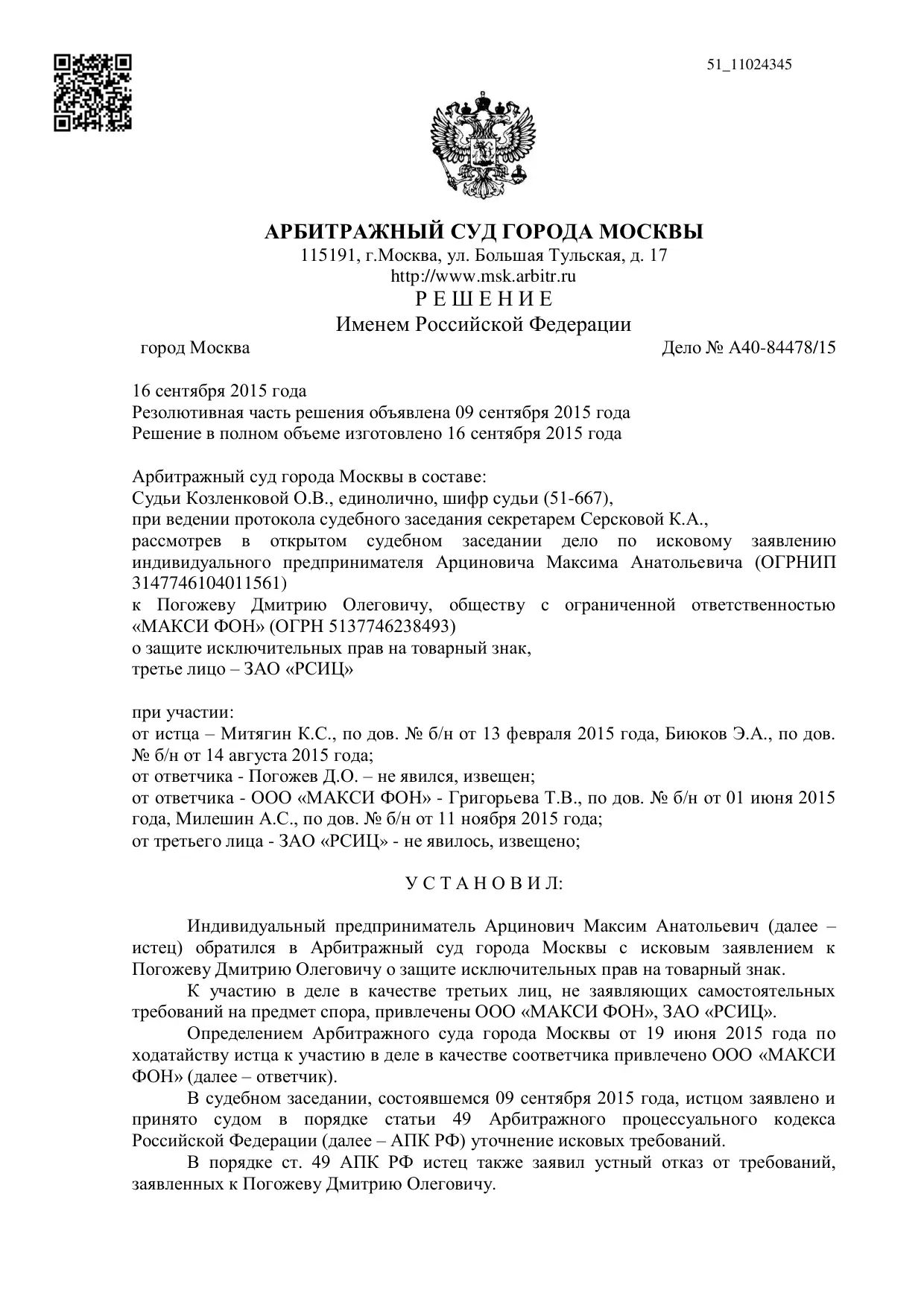
Текстовая версия
1
51_11024345
АРБИТРАЖНЫЙ СУД ГОРОДА МОСКВЫ
115191, г.Москва, ул. Большая Тульская, д. 17
Р Е Ш Е Н И Е Именем Российской Федерации город Москва Дело № А40-84478/15
16 сентября 2015 года Резолютивная часть решения объявлена 09 сентября 2015 года Решение в полном объеме изготовлено 16 сентября 2015 года Арбитражный суд города Москвы в составе: Судьи Козленковой О.В., единолично, шифр судьи (51-667), при ведении протокола судебного заседания секретарем Серсковой К.А., рассмотрев в открытом судебном заседании дело по исковому заявлению индивидуального предпринимателя Арциновича Максима Анатольевича (ОГРНИП 3147746104011561) к Погожеву Дмитрию Олеговичу, обществу с ограниченной ответственностью «МАКСИ ФОН» (ОГРН 5137746238493) о защите исключительных прав на товарный знак, третье лицо – ЗАО «РСИЦ» при участии: от истца – Митягин К.С., по дов. № б/н от 13 февраля 2015 года, Биюков Э.А., по дов. № б/н от 14 августа 2015 года; от ответчика - Погожев Д.О. – не явился, извещен; от ответчика - ООО «МАКСИ ФОН» - Григорьева Т.В., по дов. № б/н от 01 июня 2015 года, Милешин А.С., по дов. № б/н от 11 ноября 2015 года; от третьего лица - ЗАО «РСИЦ» - не явилось, извещено;
У С Т А Н О В И Л:
Индивидуальный предприниматель Арцинович Максим Анатольевич (далее – истец) обратился в Арбитражный суд города Москвы с исковым заявлением к Погожеву Дмитрию Олеговичу о защите исключительных прав на товарный знак.
К участию в деле в качестве третьих лиц, не заявляющих самостоятельных требований на предмет спора, привлечены ООО «МАКСИ ФОН», ЗАО «РСИЦ».
Определением Арбитражного суда города Москвы от 19 июня 2015 года по ходатайству истца к участию в деле в качестве соответчика привлечено ООО «МАКСИ ФОН» (далее – ответчик).
В судебном заседании, состоявшемся 09 сентября 2015 года, истцом заявлено и принято судом в порядке статьи 49 Арбитражного процессуального кодекса Российской Федерации (далее – АПК РФ) уточнение исковых требований.
В порядке ст. 49 АПК РФ истец также заявил устный отказ от требований, заявленных к Погожеву Дмитрию Олеговичу.
2
2
Третье лицо, ЗАО «РСИЦ», извещенное надлежащим образом о времени и месте судебного заседания, в судебное заседание не явилось.
С учетом своевременного размещения информации о времени и месте судебного заседания на официальном сайте арбитражного суда в сети Интернет, спор рассмотрен в его отсутствие на основании статей 121, 123, 156 АПК РФ) пункта 5 Постановления Пленума Высшего Арбитражного Суда Российской Федерации от 17 февраля 2011 года № 12 «О некоторых вопросах применения АПК РФ в редакции Федерального закона от 27 июля 2010 года № 228-ФЗ «О внесении изменений в АПК РФ».
Ответчик против удовлетворения заявленных требований возражает по доводам, изложенным в письменном отзыве.
Рассмотрев заявленные требования, выслушав представителей сторон, исследовав и оценив в материалах дела доказательства, суд пришел к следующим выводам.
Как следует из материалов дела, истец является правообладателем товарного знака по свидетельству РФ № 267434, дата подачи заявки – 30.12.2002, дата регистрации – 20.04.2004, в отношении услуг следующих классов МКТУ: 35 - продвижение товаров (для третьих лиц); снабженческие услуги для третьих лиц (закупка товаров и услуги предприятиям); 42 - дизайн художественный; услуги дизайнеров в области упаковки. В обоснование заявленных требований истец указал, что ответчик, ООО «МАКСИ ФОН», с 15 мая 2015 года является администратором доменного имени maximus.ru. Ответчик посредством данного доменного имени предлагает к продаже различные товары, то есть осуществляет коммерческую деятельность, целью которой является извлечение прибыли. Истец полагает, что данное доменное имя сходно до степени смешения с товарным знаком истца, обозначение maximus используется ответчиком в отношении услуг, однородных тем, для индивидуализации которых зарегистрирован товарный знак истца. В частности, с использованием доменного имени осуществляется продвижение товаров (для третьих лиц).
Согласно пункту 1 статьи 1225 Гражданского кодекса Российской Федерации (далее – ГК РФ) товарные знаки являются результатом интеллектуальной деятельности и приравненными к ним средствами индивидуализации юридических лиц, товаров, работ, услуг и предприятий, которым предоставляется правовая охрана.
При этом в соответствии с пунктом 2 статьи 1486 ГК РФ использованием товарного знака признается его использование правообладателем или лицом, которому такое право предоставлено на основании лицензионного договора в соответствии со статьей 1489 названного Кодекса, либо другим лицом, осуществляющим использование товарного знака под контролем правообладателя, при условии, что использование товарного знака осуществляется в соответствии с пунктом 2 статьи 1484 этого Кодекса, за исключением случаев, когда соответствующие действия не связаны непосредственно с введением товара в гражданский оборот, а также использование товарного знака с изменением его отдельных элементов, не влияющим на его различительную способность и не ограничивающим охрану, предоставленную товарному знаку.
Исходя из названной нормы права, исключительное право на товарный знак может быть осуществлено для индивидуализации товаров, работ или услуг, в отношении которых товарный знак зарегистрирован, в частности путем размещения товарного знака:
- на товарах, в том числе на этикетках, упаковках товаров, которые производятся, предлагаются к продаже, продаются, демонстрируются на выставках и ярмарках или иным образом вводятся в гражданский оборот на территории Российской
3
3
Федерации, либо хранятся или перевозятся с этой целью, либо ввозятся на территорию Российской Федерации;
при выполнении работ, оказании услуг; 3) на документации, связанной с введением товаров в гражданский оборот; 4) в предложениях о продаже товаров, о выполнении работ, об оказании услуг, а также в объявлениях, на вывесках и в рекламе;
в сети «Интернет», в том числе в доменном имени и при других способах адресации.
На основании пункта 1 статьи 1229 Гражданского кодекса Российской Федерации правообладатель может по своему усмотрению разрешать или запрещать другим лицам использование результата интеллектуальной деятельности. Отсутствие запрета не считается согласием (разрешением). Другие лица не могут использовать соответствующие результат интеллектуальной деятельности или средство индивидуализации без согласия правообладателя, за исключением случаев, предусмотренных названным Кодексом.
Использование результата интеллектуальной деятельности или средства индивидуализации, если такое использование осуществляется без согласия правообладателя, является незаконным и влечет ответственность.
В силу пункта 3 статьи 1484 ГК РФ никто не вправе использовать без разрешения правообладателя сходные с его товарным знаком обозначения в отношении товаров, для индивидуализации которых товарный знак зарегистрирован, или однородных товаров, если в результате такого использования возникнет вероятность смешения.
В соответствии с пунктом 14.4.3 Правил составления, подачи и рассмотрения заявки на регистрацию товарного знака и знака обслуживания, утвержденных приказом Российского агентства по патентам и товарным знакам от 05.03.2003 № 32, для установления однородности товаров принимается во внимание род (вид) товаров, их назначение, вид материала, из которого они изготовлены, условия сбыта товаров, круг потребителей и другие признаки.
Как отмечено в Постановлении Президиума Высшего Арбитражного Суда Российской Федерации от 17.09.2013 № 5793/13, при установлении однородности товаров суды должны принимать во внимание следующие обстоятельства: род (вид) товаров, их потребительские свойства и функциональное назначение (объем и цель применения), вид материала, из которого они изготовлены, взаимодополняемость либо взаимозаменяемость товаров, условия их реализации (в том числе общее место продажи, продажу через розничную либо оптовую сеть), круг потребителей, традиционный или преимущественный уклад использования товаров.
Кроме того, с учетом правовой позиции, выработанной Высшим Арбитражным Судом Российской Федерации в Постановлениях Президиума от 24.12.2002 № 10268/02 и от 18.07.2006 № 2979/06 по вопросу об однородности товаров, однородность признается по факту, если товары по причине их природы или назначения могут быть отнесены потребителями к одному и тому же источнику происхождения.
Исковые требования мотивированы тем, что истец не предоставлял согласия ответчику, ЗАО «МАКСИ ФОН», на использование товарного знака в спорном доменном имени «maximus.ru».
Статья 10.bis Парижской конвенции содержит общий запрет недобросовестной конкуренции, под которой, как следует из параграфа 2 этой статьи, понимаются всякие акты, противоречащие честным обычаям в промышленных и торговых делах. В частности, подлежат запрету все действия, способные каким бы то ни было способом вызвать смешение в отношении предприятия, продуктов или промышленной или торговой деятельности конкурента.
4
4
В Постановлении от 11.11.2008 по делу № 5560/08 Президиумом Высшего Арбитражного Суда Российской Федерации указано, что, оценивая действия администратора домена на предмет наличия или отсутствия в его действиях акта недобросовестной конкуренции, запрещенной статьей 10.bis Парижской конвенции, суд проверяет наличие или отсутствие трех критериев в совокупности: доменное имя идентично или сходно до степени смешения с товарным знаком третьего лица; у владельца доменного имени нет каких-либо законных прав и интересов в отношении доменного имени; доменное имя зарегистрировано и используется недобросовестно.
Как следует из материалов дела, администратором спорного доменного имени ответчик, ЗАО «МАКСИ ФОН», является с 15 мая 2015 года.
Ответчик является правообладателем товарного знака по свидетельству РФ № 248262, дата подачи заявки – 11.09.2002, дата регистрации – 05.06.2003, в том числе, в отношении услуг класса МКТУ: 35 - реклама; менеджмент в сфере бизнеса; административная деятельность в сфере бизнеса; офисная служба. Исключительные права на вышеуказанный товарный знак ответчик приобрел на основании договора отчуждения исключительных прав зарегистрированным в Государственном реестре 19.11.2014 за номером РД0162077.
Ответчик была зарегистрирована в государственном реестре юридических лиц 25.12.2013.
В представленном в материалы дела отзыве ответчик указал, что с этой даты ООО «МАКСИ ФОН» стало одной из компаний, входящих в Группу компаний «Максимус». Постоянными учредителями (участниками) всех компаний, входящих в эту Группу являются Колла Сунил Кумар и Усейнашвили Мираби Олегович. Основным видом деятельности ООО «МАКСИ ФОН», как и остальных компаний из Группы компаний «Максимус», является оптовая торговля электротоварами и бытовыми электроустановочными изделиями, а также деятельность в области телефонной связи и документальной электросвязи. Большое внимание в последнее время уделяется дистанционной торговле через интернет-магазин.
Для этой цели, Учредителями Группы компаний «Максимус» было принято решение предложить Погожеву Д.О., входящему в состав директоров Группы компаний «Максимус», подать заявление в Региональный Сетевой Информационный центр, о передачи прав на доменное имя второго уровня maximus.ru на ООО «МАКСИ ФОН».
На сайте с доменным именем maximus.ru размещается рекламная информация и предложение к продаже товаров, которые ООО «МАКСИ ФОН» получает на основании договоров поставки с такими крупными компаниями как «САМСУНГ», «ЭКСПЛЕЙ», «СОНИ ЭЛЕКТРОНИКС». С этими компаниями заключаются дистрибьюторский договоры, в рамках которых ООО «МАКСИ ФОН» закупает у этих фирм мобильные телефоны, цифровые аудио-видео, компьютерная и цифровая техника, расходные и другие товары. Для целей реализации приобретенных товаров ООО «МАКСИ ФОН» размещает рекламную информацию об этих товарах и их производителей.
Суд считает, что исковые требования не подлежат удовлетворению в связи с нижеследующим.
Как установлено судом, ответчик на спорном сайте размещает свой комбинированный товарный знак «МАКСИМУС» № 248262 в том виде, в котором он зарегистрирован.
Зарегистрированное доменное имя maximus.ru является воспроизведением буквами латинского алфавита обозначения «Максимус» - словесного элемента комбинированного товарного знака № 248262, зарегистрированного (05.06.2003) ранее даты регистрации товарного знака истца «MAXIMUS» по свидетельству № 267434 (20.04.2004).
5
5
Ответчик указал, что регистрация домена была произведена буквами латинского алфавита, так как на дату регистрации доменного имени в зоне RU не была предусмотрена регистрация домена в кириллице.
Таким образом, при осуществлении деятельности ответчик использует свой товарный знак, который имеет более раннюю дату приоритета (регистрации), чем товарный знак истца.
Суд считает необходимым отметить, что товарный знак истца зарегистрирован для услуг 35 класса МКТУ (продвижение товаров (для третьих лиц)).
Товарный знак ответчика зарегистрирован в отношении услуг 35 класса МКТУ (реклама).
Услуга «продвижение товаров» представляет собой широкое понятие, которое включает совокупность разных мер, усилий, действий, предпринимаемых в целях повышения спроса на товары, увеличения их сбыта, расширения рыночного поля товаров, к ней могут относиться и услуги в области рекламы, и услуги магазинов по осуществлению розничной продажи товаров конечному потребителю. В силу изложенного из общей совокупности услуг по продвижению товаров можно выделить услуги, связанные с розничной торговлей, которые осуществляются непосредственно торговыми предприятиями (магазинами) и отличаются от услуг в области рекламы тем, что относятся к другому роду услуг, характеризуются иной целью, другим способом оказания и кругом потребителей.
В подтверждение того обстоятельства, что ответчиком оказываются услуги, однородные тем, для индивидуализации которых зарегистрирован товарный знак истца, истцом в материалы дела представлен скриншот сайта www.maximus.ru , из которого следует, что ответчик рекламирует различные товары (ноутбуки, смартфоны и т.д.).
Доказательств оказания ответчиком иной деятельности истцом в материалы дела не представлено.
В материалы дела истцом представлено ходатайство ответчика о частичном досрочном прекращении действия правовой охраны товарного знака со словесным обозначением «MAXIMUS» по свидетельству Российской Федерации № 267434 вследствие его неиспользования, направленное ответчиком в Суд по интеллектуальным правам.
Суд считает необходимым отметить, что доводы ответчика, изложенные в вышеуказанном ходатайстве, подлежат оценке и соответствующему доказыванию в рамках рассмотрения дела в Суде по интеллектуальным правам.
При рассмотрении настоящего дела ответчик отрицал однородность оказываемых им услуг с услугами, для которых зарегистрирован товарный знак истца.
Исходя из представленных в материалы дела доказательств, суд приходит к выводу об отсутствии в действиях ответчика нарушения исключительных прав истца на товарный знак по свидетельству Российской Федерации № 267434.
Расходы по госпошлине относятся на истца. Руководствуясь ст.ст. 106, 110, 167-170, 176 АПК РФ,
РЕШИЛ:
Принять отказ от требований к Погожеву Дмитрию Олеговичу. Производство по делу в данной части прекратить. В удовлетворении остальной части исковых требований отказать. Решение может быть обжаловано в течение месяца с момента принятия в Девятый арбитражный апелляционный суд.
Судья: О.В. Козленкова
Перевод неофициальный.
Decision of the Arbitrazh Court of the City of Moscow of 16 September 2015, case No. A40-84478/15 (MAXIMUS trademark)
[[PAGE 1]]
[Document No. 51_11024345]
ARBITRAZH COURT OF THE CITY OF MOSCOW
115191, Moscow, Bolshaya Tulskaya Street 17 — http://www.msk.arbitr.ru
DECISION — In the Name of the Russian Federation
City of Moscow — Case No. A40-84478/15 — 16 September 2015
The operative part of the decision was announced on 9 September 2015. The decision was drawn up in full on 16 September 2015.
The Arbitrazh Court of the City of Moscow, composed of Judge O. V. Kozlenkova sitting alone, judge's code (51-667), with the record of the hearing kept by clerk K. A. Serskova, having examined in open court the case on the statement of claim of individual entrepreneur Maxim Anatolyevich Artsinovich (entrepreneur registration number 3147746104011561) against Dmitry Olegovich Pogozhev and the limited liability company "MAXI FON" (main state registration number 5137746238493) for the protection of exclusive rights to a trademark, third party — ZAO "RSITs",
with the participation of: for the claimant — K. S. Mityagin, by power of attorney without number of 13 February 2015, and E. A. Biyukov, by power of attorney without number of 14 August 2015; for the respondent D. O. Pogozhev — did not appear, notified; for the respondent OOO "MAXI FON" — T. V. Grigorieva, by power of attorney without number of 1 June 2015, and A. S. Mileshin, by power of attorney without number of 11 November 2015; for the third party ZAO "RSITs" — did not appear, notified;
HAS ESTABLISHED:
Individual entrepreneur Maxim Anatolyevich Artsinovich (hereinafter — the claimant) applied to the Arbitrazh Court of the City of Moscow with a statement of claim against Dmitry Olegovich Pogozhev for the protection of exclusive rights to a trademark.
OOO "MAXI FON" and ZAO "RSITs" were joined to the case as third parties not making independent claims in respect of the subject matter of the dispute.
By ruling of the Arbitrazh Court of the City of Moscow of 19 June 2015, at the claimant's request, OOO "MAXI FON" (hereinafter — the respondent) was joined to the case as a co-respondent.
At the hearing held on 9 September 2015 the claimant made, and the court accepted under Article 49 of the Arbitrazh Procedure Code of the Russian Federation (hereinafter — the APC RF), a clarification of the claims.
Under Article 49 of the APC RF the claimant also made an oral withdrawal of the claims brought against Dmitry Olegovich Pogozhev.
[[PAGE 2]]
The third party, ZAO "RSITs", duly notified of the time and place of the hearing, did not appear at the hearing.
Given the timely posting of information about the time and place of the hearing on the official website of the arbitrazh court on the Internet, the dispute was examined in its absence on the basis of Articles 121, 123 and 156 of the APC RF and paragraph 5 of the Resolution of the Plenum of the Supreme Arbitrazh Court of the Russian Federation of 17 February 2011 No. 12.
The respondent objects to the claims being granted on the grounds set out in its written response.
Having examined the claims made, heard the representatives of the parties, and examined and assessed the evidence in the case file, the court has reached the following conclusions.
As is apparent from the case file, the claimant is the holder of a trademark under Russian Federation certificate No. 267434, application filing date 30.12.2002, registration date 20.04.2004, in respect of services in the following classes of the Nice Classification: 35 — promotion of goods (for third parties); procurement services for third parties (purchase of goods and services for undertakings); 42 — artistic design; designers' services in the field of packaging.
In support of the claims made, the claimant stated that the respondent, OOO "MAXI FON", has since 15 May 2015 been the administrator of the domain name maximus.ru. Through that domain name the respondent offers various goods for sale, that is to say, carries on commercial activity for profit.
The claimant considers that this domain name is confusingly similar to the claimant's trademark, and that the designation maximus is used by the respondent in respect of services that are similar to those for the individualisation of which the claimant's trademark is registered. In particular, the domain name is used for the promotion of goods (for third parties).
Under Article 1225(1) of the Civil Code of the Russian Federation (hereinafter — the CC RF), trademarks are results of intellectual activity and means of individualisation of legal persons, goods, works, services and undertakings equated to them, to which legal protection is afforded.
Under Article 1486(2) of the CC RF, use of a trademark means its use by the right holder or by a person to whom such a right has been granted under a licence agreement in accordance with Article 1489 of that Code, or by another person using the trademark under the control of the right holder, provided that the trademark is used in accordance with Article 1484(2) of that Code, except where the relevant acts are not directly connected with placing the goods in civil circulation, as well as use of a trademark with a modification of individual elements which does not affect its distinctiveness and does not limit the protection afforded to the trademark.
On the basis of that rule of law, the exclusive right to a trademark may be exercised for the individualisation of goods, works or services in respect of which the trademark is registered, in particular by placing the trademark:
- on goods, including on labels and packaging of goods that are produced, offered for sale, sold, displayed at exhibitions and fairs or otherwise placed in civil circulation on the territory of the Russian
[[PAGE 3]]
Federation, or are stored or transported for that purpose, or are imported into the territory of the Russian Federation;
2) in the performance of works or the provision of services;
3) on documentation connected with placing goods in civil circulation;
4) in offers for the sale of goods, the performance of works or the provision of services, as well as in announcements, on signboards and in advertising;
5) on the Internet, including in a domain name and in other means of addressing.
Under Article 1229(1) of the Civil Code of the Russian Federation, the right holder may at its discretion permit or prohibit the use of the result of intellectual activity by other persons. The absence of a prohibition is not deemed to be consent (permission). Other persons may not use the relevant result of intellectual activity or means of individualisation without the right holder's consent, except in the cases provided for by that Code.
The use of a result of intellectual activity or of a means of individualisation, where such use is carried out without the right holder's consent, is unlawful and entails liability.
Under Article 1484(3) of the CC RF, no one is entitled to use, without the right holder's permission, designations similar to its trademark in respect of goods for the individualisation of which the trademark is registered, or similar goods, if as a result of such use a likelihood of confusion arises.
Under paragraph 14.4.3 of the Rules for drawing up, filing and examining an application for the registration of a trademark and service mark, approved by order of the Russian Agency for Patents and Trademarks of 05.03.2003 No. 32, in order to establish the similarity of goods, account is taken of the kind (type) of goods, their purpose, the type of material from which they are made, the conditions of their sale, the range of consumers and other features.
As noted in the Resolution of the Presidium of the Supreme Arbitrazh Court of the Russian Federation of 17.09.2013 No. 5793/13, when establishing the similarity of goods the courts must take into account the following circumstances: the kind (type) of goods, their consumer properties and functional purpose (scope and aim of use), the type of material from which they are made, the complementarity or interchangeability of the goods, the conditions of their sale (including a common place of sale, sale through a retail or wholesale network), the range of consumers, and the traditional or predominant pattern of use of the goods.
In addition, having regard to the legal position developed by the Supreme Arbitrazh Court of the Russian Federation in the Resolutions of the Presidium of 24.12.2002 No. 10268/02 and of 18.07.2006 No. 2979/06 on the question of the similarity of goods, similarity is recognised as a matter of fact if the goods, by reason of their nature or purpose, may be attributed by consumers to one and the same source of origin.
The claims are based on the fact that the claimant did not give its consent to the respondent, ZAO "MAXI FON", to use the trademark in the disputed domain name "maximus.ru".
Article 10bis of the Paris Convention contains a general prohibition of unfair competition, which, as follows from paragraph 2 of that article, means any act contrary to honest practices in industrial or commercial matters. In particular, all acts of such a nature as to create confusion by any means whatever with the establishment, the goods, or the industrial or commercial activities, of a competitor are to be prohibited.
[[PAGE 4]]
In its Resolution of 11.11.2008 in case No. 5560/08, the Presidium of the Supreme Arbitrazh Court of the Russian Federation indicated that, in assessing the acts of a domain administrator for the presence or absence of an act of unfair competition prohibited by Article 10bis of the Paris Convention, the court verifies the presence or absence of three criteria cumulatively: the domain name is identical or confusingly similar to a third party's trademark; the owner of the domain name has no rights or legitimate interests in respect of the domain name; the domain name has been registered and is being used in bad faith.
As is apparent from the case file, the respondent, ZAO "MAXI FON", has been the administrator of the disputed domain name since 15 May 2015.
The respondent is the holder of a trademark under Russian Federation certificate No. 248262, application filing date 11.09.2002, registration date 05.06.2003, including in respect of services in class 35 of the Nice Classification: advertising; business management; business administration; office functions.
The respondent acquired the exclusive rights to the above trademark under an agreement on the alienation of exclusive rights registered in the State Register on 19.11.2014 under number RD0162077.
The respondent was registered in the state register of legal persons on 25.12.2013.
In the response submitted to the case file, the respondent stated that from that date OOO "MAXI FON" became one of the companies forming part of the "Maximus" group of companies. The permanent founders (participants) of all the companies in that group are Kolla Sunil Kumar and Mirabi Olegovich Useynashvili. The main activity of OOO "MAXI FON", like that of the other companies in the "Maximus" group, is the wholesale trade in electrical goods and household electrical installation products, as well as activities in the field of telephone communications and documentary telecommunications. Considerable attention has recently been paid to distance selling through an online shop.
To that end, the founders of the "Maximus" group of companies decided to propose to D. O. Pogozhev, who is one of the directors of the "Maximus" group of companies, that he apply to the Regional Network Information Centre for the transfer of the rights to the second-level domain name maximus.ru to OOO "MAXI FON".
The website with the domain name maximus.ru carries advertising information and offers for the sale of goods which OOO "MAXI FON" receives under supply agreements with such large companies as "SAMSUNG", "EXPLAY" and "SONY ELECTRONICS". Distribution agreements are concluded with those companies, under which OOO "MAXI FON" purchases from them mobile telephones, digital audio and video, computer and digital equipment, consumables and other goods. For the purposes of selling the goods purchased, OOO "MAXI FON" posts advertising information about those goods and their manufacturers.
The court considers that the claims are not to be granted, on the following grounds.
As established by the court, on the disputed website the respondent places its combined trademark "MAXIMUS" No. 248262 in the form in which it is registered.
The registered domain name maximus.ru is a reproduction in Latin letters of the designation "Максимус" — the verbal element of combined trademark No. 248262, registered (05.06.2003) earlier than the registration date of the claimant's trademark "MAXIMUS" under certificate No. 267434 (20.04.2004).
[[PAGE 5]]
The respondent stated that the domain was registered in Latin letters because, at the date of registration of the domain name in the RU zone, registration of a domain in Cyrillic was not provided for.
Thus, in carrying on its activities the respondent uses its own trademark, which has an earlier priority (registration) date than the claimant's trademark.
The court considers it necessary to note that the claimant's trademark is registered for services in class 35 of the Nice Classification (promotion of goods (for third parties)).
The respondent's trademark is registered in respect of services in class 35 of the Nice Classification (advertising).
The service of "promotion of goods" is a broad concept which includes a range of different measures, efforts and actions undertaken with a view to increasing demand for goods, increasing their sales and expanding the market field of the goods; it may include both services in the field of advertising and the services of shops in the retail sale of goods to the end consumer. Accordingly, from the overall range of goods-promotion services one may distinguish services connected with retail trade, which are provided directly by trading undertakings (shops) and which differ from services in the field of advertising in that they belong to a different kind of service, are characterised by a different aim, a different method of provision and a different range of consumers.
In confirmation of the fact that the respondent provides services similar to those for the individualisation of which the claimant's trademark is registered, the claimant submitted to the case file a screenshot of the website www.maximus.ru, from which it follows that the respondent advertises various goods (laptops, smartphones, etc.).
The claimant has submitted no evidence to the case file that the respondent carries on any other activity.
The claimant submitted to the case file the respondent's application for the partial early termination of the legal protection of the trademark with the verbal designation "MAXIMUS" under Russian Federation certificate No. 267434 on account of its non-use, which the respondent sent to the Intellectual Property Court.
The court considers it necessary to note that the respondent's arguments set out in the above application are subject to assessment and appropriate proof in the framework of the examination of the case by the Intellectual Property Court.
In the examination of the present case the respondent denied that the services it provides are similar to the services for which the claimant's trademark is registered.
On the basis of the evidence submitted to the case file, the court concludes that the respondent's acts do not infringe the claimant's exclusive rights to the trademark under Russian Federation certificate No. 267434.
The costs of the State fee are borne by the claimant.
Guided by Articles 106, 110, 167–170 and 176 of the APC RF,
HAS DECIDED:
To accept the withdrawal of the claims against Dmitry Olegovich Pogozhev.
To terminate the proceedings in that part.
To dismiss the remainder of the claims.
The decision may be appealed against within one month of its adoption to the Ninth Arbitrazh Court of Appeal.
Judge: O. V. Kozlenkova